
Marie Dominique Schmidt; Ioannis Iossifidis Decoding motor intention early and reliably is central to responsive assistive devices and adaptive rehabilitation. In this study, we investigate how precisely movement direction and target location can be inferred from multichannel EMG signals, and how early this information becomes available relative to movement onset. We present a pipeline combining … Read More “New preprint: The Spatial and Temporal Resolution of Motor Intention in Multi-Target Prediction” »
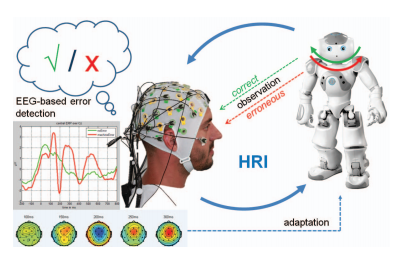
New paper: Performance Boundaries for BCIs Using Error-Related Potentials and Reinforcement Learning
Aline Xavier Fidêncio; Felix Grün; Christian Klaes; Ioannis Iossifidis Non-invasive BCIs are promising assistive technologies, but real-world EEG is non-stationary—often causing performance to degrade over time. One route to robustness is to adapt the system online using feedback signals. In this work we study the limits of a closed-loop BCI framework that uses error-related potentials … Read More “New paper: Performance Boundaries for BCIs Using Error-Related Potentials and Reinforcement Learning” »
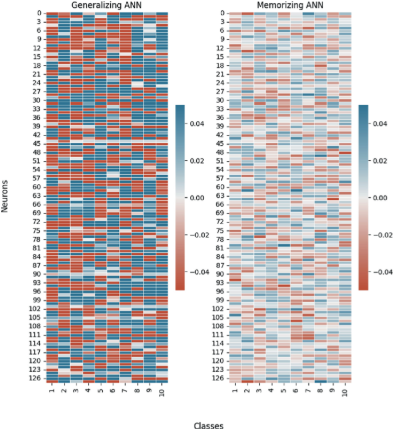
Stephan Johann Lehmler; Muhammad Saif-ur-Rehman; Tobias Glasmachers; Ioannis Iossifidis How can we tell whether a neural network is learning generalizable structure versus memorizing rare patterns? In this paper, we study distributional signatures inside networks trained under memorization-heavy regimes. Our starting point is the idea that memorization corresponds to learning “rare” input features—an effect that can … Read More “New paper: Distributional Properties of ReLU-Activations in Neural Networks That Learn by Memorization” »
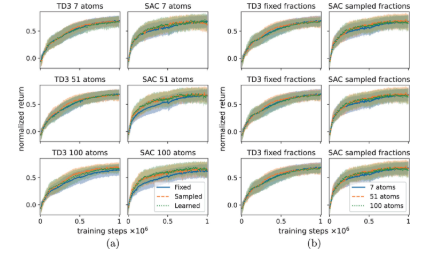
Felix Grün; Muhammad Saif-ur-Rehman; Tobias Glasmachers; Ioannis Iossifidis Distributional reinforcement learning has delivered strong results in discrete-action benchmarks, largely driven by different ways of representing value distributions (e.g., via quantiles) and comparing them during training. In this work, we bring three prominent distributional methods—QR-DQN, IQN, and FQF—into the continuous action domain by integrating distributional critics … Read More “New paper: Invariance to Quantile Selection in Distributional Continuous Control” »
🚀 Wir freuen uns, bekannt zu geben, dass das Iossifidis Lab an der Bernstein-Konferenz teilgenommen und dort spannende Forschungsarbeiten unserer talentierten Teammitglieder Marie Dominique Schmidt, Aline Xavier Fidencio, Felix Grün und Stephan Lehmler präsentiert hat. Unsere Beiträge umfassten:🔹 Error-related potentials and reinforcement learning for neuroadaptive systems Fidêncio AX, Iossifidis I 🔹 A Framework to Model Your Model-Based / … Read More “Iossifidis Lab auf der Bernstein Konferenz 2025” »
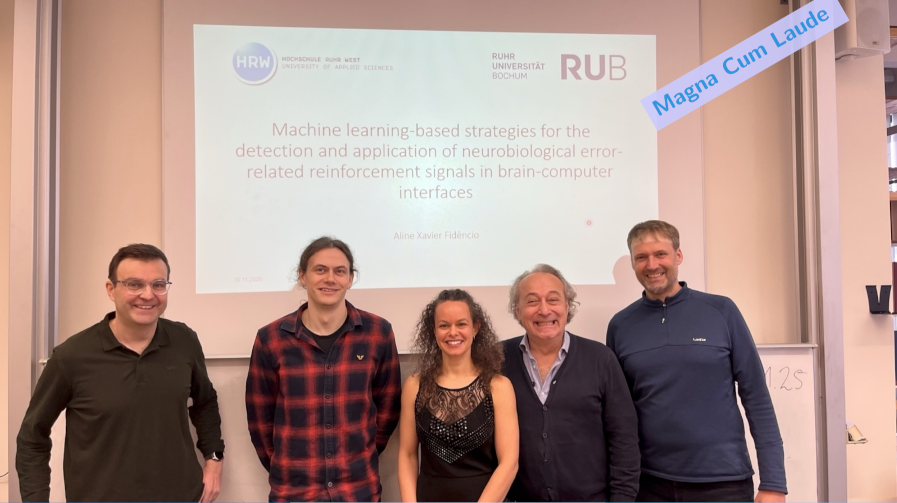
Wir gratulieren Dr. Aline Xavier Fidencio ganz herzlich zur erfolgreichen Verteidigung ihrer Dissertation! 🏆 Eine herausragende Leistung Am 10. November 2025 hat Aline Xavier Fidencio ihre Dissertation mit der Bestnote magna cum laude erfolgreich verteidigt. „Machine learning-based strategies for detection and application of neurobiological error-related reinforcement signals in brain-computer interfaces” Kommission: Ioannis Iossifidis (Gutachter), Tobias Glasmachers (Gutachter), Nils Fleischhacker (Vorsitz), Axel … Read More “Erfolgreiche Promotion von Aline Xavier Fidencio mit magna cum laude — Herzlichen Glückwunsch!🎉🎓✨” »
Value Iteration in Grid World Value Iteration in Grid World Grid Größe: Gamma: Theta: Initialisieren Positionen der Hindernisse (x,y Paare): Zielposition (x,y): Bellman-Gleichung für Value Iteration: V(s) = maxa Σs’ [P(s’|s,a) * (R(s,a,s’) + γ * V(s’))] Wo: V(s) der Wert des Zustands s ist P(s’|s,a) die Übergangswahrscheinlichkeit ist (hier angenommen als deterministisch, daher = … Read More “Gridworld RL” »
Erklärung des Codes:
Numerische Lösungsmethoden Numerische Lösungsmethoden für ODEs Vergleich von Euler- und Runge-Kutta-4-Methoden Startzeit (t_start): Endzeit (t_end): Anzahl Schritte (n_steps): Anfangswert (y0): Differentialgleichung (y\’ = f(t, y)): Berechnen und Zeichnen