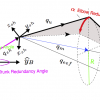

Inspired by those findings a model based on dynamical systems was proposed both, to model goal directed trajectories in humans and to generate trajectories for redundant anthropomorphic robotic arms. The analysis of the attractor dynamics based on the qualitative comparison with measurements of resulting trajectories taken from arm movement experiments with humans (Grimme u. a., 2012) created a framework able to reproduce and to generate naturalistic human like arm trajectories (Iossifidis und Rano, 2013; Iossifidis, Schöner u. a., 2006).
Category: Conference participation
In the current work a closed form solution for a multi redundant open chain manipulator is presented. Exploiting the geometrical properties of the open chain we derive first ananalytic solution for the seven degree of freedom arm. And introduce then a methodology to incorporate additional degree of freedoms in the chain preserving the closed form … Read More “ICRA2013:Closed Form Solution for Inverse Kinematical Mapping for Redundant Open Chain Manipulators (submitted)” »
In the current work a closed form solution for a multi redundant open chain manipulator is presented. Exploiting the geometrical properties of the open chain we derive first an analytic solution for the seven degree of freedom arm. And introduce then a methodology to incorporate additional degree of freedoms in the chain preserving the closed … Read More “ICRA2013:Closed Form Solution for Inverse Kinematical Mapping for Redundant Open Chain Manipulators(submitted)” »
Movement generation in robotics is a well know problem with many excellent solutions. Most of them, however, look for optimal solutions according to some metrics, but have no biological inspiration. From a human perspective these techniques behave in a non-naturalistic way. This poses a problem for human-robot interaction and, in general, for a good acceptance … Read More “Robio2013:Modeling Human Arm Motion by Means of Attractor Dynamics Approach” »
Treffen Sie uns auf der ITSC2012 in Alaska. Wir präsentieren unsere Arbeit zur Entwicklung einer integrierten Architektur zur Entwicklung und Prüfung von Fahrerassistenzsystemen. Abastract: Advanced Driver Assistant Systems act, by definition in natural, often poorly structured, environments and are supposed to closely interact with human operators. Both, natural environments as well as human behaviour have no … Read More “ITSC2012: An Integrated Architecture for the Development and Assessment of ADAS” »
Meet us at the ITSC2012 in Alaska. We will present our work about an integrated architecture for the development and assessment of ADAS. Abastract: Advanced Driver Assistant Systems act, by definition in natural, often poorly structured, environments and are supposed to closely interact with human operators. Both, natural environments as well as human behaviour have no … Read More “ITSC2012: An Integrated Architecture for the Development and Assessment of ADAS” »

Over the last decades the generation mechanism and the representation of goal- directed movements has been a topic of intensive neurophysiological research. The investigation in the motor, premotor, and parietal areas led to the discovery that the direction of hand’s movement in space was encoded by populations of neurons in these areas together with many other movement parameters. These distributions of population activation reflect how movements are prepared ahead of movement initiation, as revealed by activity induced by cues that precede the imperative signal (Georgopoulos, 1991).