
Skip to content
iLab: From Brain to Machine and Back

iLab: From Brain to Machine and Back

iossifidis Lab

  • Home
  • Research Projects
  • Publications
  • Software
  • Press and Media
  • Student’s Zone — Teaching
    • Thesis topics
    • Student Projects
    • Journal Club & Progress Club
    • Lab Course
    • Lectures – Vorlesungen
  • About us
    • The Team
    • Contact
    • Impressum
  • Home
  • 2020
  • December
  • 1
  • Improving the performance of EEG decoding using anchored-STFT in conjunction with gradient norm adversarial augmentation
Improving the performance of EEG decoding using anchored-STFT in conjunction with gradient norm adversarial augmentation

Improving the performance of EEG decoding using anchored-STFT in conjunction with gradient norm adversarial augmentation

Posted on December 1, 2020December 1, 2020 By Muhammad Saif-Ur-Rehman No Comments on Improving the performance of EEG decoding using anchored-STFT in conjunction with gradient norm adversarial augmentation
publication, scientific publication

Preprint

https://arxiv.org/abs/2011.14694

Abstract
Objective. Brain-computer interfaces (BCIs) enable direct communication between humans and machines by translating brain activity into control commands. Electroencephalography (EEG) is one of the most common sources of neural signals because of its inexpensive and non-invasive
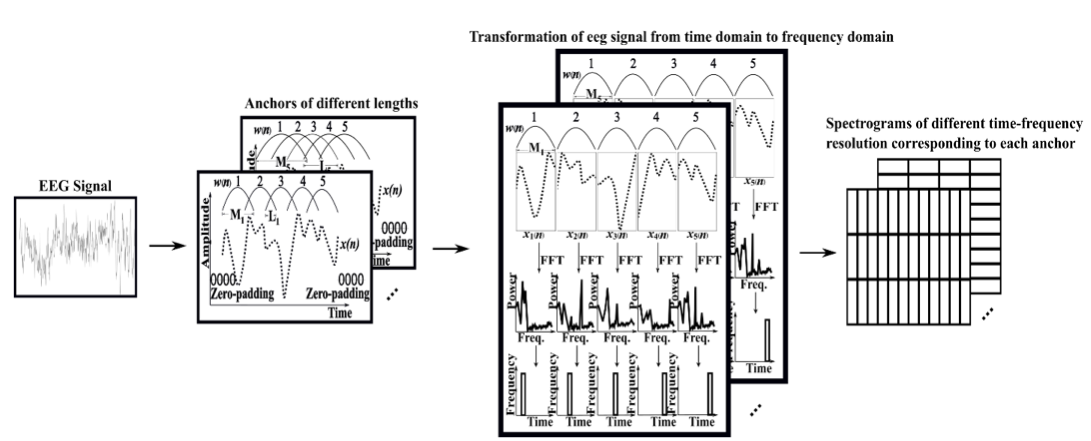
nature. However, interpretation of EEG signals is non-trivial because EEG signals have a low spatial resolution and are often distorted with noise and artifacts. Therefore, it is possible that meaningful patterns for classifying EEG signals are deeply hidden. Nowadays, state-of-the-art deep-learning algorithms have proven to be quite efficient in learning hidden, meaningful patterns. However, the performance of the deep learning algorithms depends upon the quality and the amount of the provided training data. Hence, a better input formation (feature extraction) technique and a generative model to produce high-quality data can enable the deep learning algorithms to adapt high generalization quality. Approach. In this study, we proposed a novel input formation (feature extraction) method in conjunction with a novel deep learning based generative model to harness new training examples. The inputs (feature vectors) are formed (extracted) using a modified Short Time Fourier Transform (STFT) called anchored-STFT. Anchored-STFT, inspired by wavelet transform, tries to minimize the tradeoff between time and frequency resolution. As a result, it extracts the inputs (feature vectors) with better time and frequency resolution compared to the standard STFT. Secondly, we introduced a novel generative adversarial data augmentation technique called gradient norm adversarial augmentation (GNAA) for generating more training data. Thirdly, we investigated the existence and significance of adversarial inputs in EEG data. Main Results. We evaluated our methods on BCI competition II dataset III and BCI competition IV dataset 2b. Our approach obtained the kappa value of 0.814 for BCI competition II dataset III and 0.755 for BCI competition IV dataset 2b for session-to-session transfer on evaluation data. For BCI competition II dataset III, our approach yielded 3.9% and 1.75% improvement over the winner algorithm and the state-of-the-art result, respectively, whereas, for BCI competition IV dataset 2b, our approach yielded 6.5% improvement over the winner algorithm of the competition.
Significance. The results of this study show that the proposed methods can enhance the classification accuracy of BCI decoding applications. To the best of our knowledge, we are the first to investigate the existence of adversarial inputs on the neural data by applying adversarial perturbation using a novel method.

Post navigation

❮ Previous Post: SpikeDeep-Classifier: A deep-learning based fully automatic offline spike sorting algorithm
Next Post: Application of Reinforcement Learning to a Mining System ❯

Leave a Reply Cancel reply

Your email address will not be published. Required fields are marked *

Recent Posts

  • (no title) June 18, 2026
  • New journal article: Predicting Muscle Activity from Upper Limb Kinematics with LSTM Networks June 7, 2026
  • New preprint: The Spatial and Temporal Resolution of Motor Intention in Multi-Target Prediction June 7, 2026
  • New paper: Performance Boundaries for BCIs Using Error-Related Potentials and Reinforcement Learning June 7, 2026
  • New paper: Distributional Properties of ReLU-Activations in Neural Networks That Learn by Memorization June 7, 2026

Recent Comments

    Archives

    • June 2026
    • May 2026
    • October 2025
    • January 2025
    • October 2024
    • September 2024
    • September 2023
    • June 2023
    • December 2022
    • October 2022
    • September 2022
    • May 2022
    • February 2022
    • January 2022
    • November 2021
    • August 2021
    • June 2021
    • April 2021
    • March 2021
    • February 2021
    • December 2020
    • November 2020
    • October 2020
    • September 2020
    • September 2019
    • October 2018
    • December 2017
    • September 2017
    • July 2016
    • December 2015
    • November 2013
    • October 2013
    • August 2013
    • May 2013
    • July 2012
    • March 2012
    • February 2012
    • January 2012
    • December 2011
    • September 2011
    • March 2011
    • June 2010
    • May 2010
    • April 2010
    • March 2010
    • September 2009
    • July 2009
    • May 2009
    • April 2009
    • March 2009
    • February 2009

    Categories

    • Conference participation
    • Grant
    • invited talk
    • journal club
    • press release
    • progress club
    • publication
    • research grand
    • scientific publication
    • software released
    • teaching
    • workshop

    Meta

    • Log in
    • Entries feed
    • Comments feed
    • WordPress.org

    Copyright © Ioannis Iossifidis 2020 iLab: From Brain to Machine and Back.

    Theme: Oceanly by ScriptsTown

    We use cookies on our website to give you the most relevant experience by remembering your preferences and repeat visits. By clicking “Accept All”, you consent to the use of ALL the cookies. However, you may visit "Cookie Settings" to provide a controlled consent.
    Cookie SettingsAccept All
    Manage consent

    Privacy Overview

    This website uses cookies to improve your experience while you navigate through the website. Out of these, the cookies that are categorized as necessary are stored on your browser as they are essential for the working of basic functionalities of the website. We also use third-party cookies that help us analyze and understand how you use this website. These cookies will be stored in your browser only with your consent. You also have the option to opt-out of these cookies. But opting out of some of these cookies may affect your browsing experience.
    Necessary
    Always Enabled
    Necessary cookies are absolutely essential for the website to function properly. These cookies ensure basic functionalities and security features of the website, anonymously.
    CookieDurationDescription
    cookielawinfo-checkbox-analytics11 monthsThis cookie is set by GDPR Cookie Consent plugin. The cookie is used to store the user consent for the cookies in the category "Analytics".
    cookielawinfo-checkbox-functional11 monthsThe cookie is set by GDPR cookie consent to record the user consent for the cookies in the category "Functional".
    cookielawinfo-checkbox-functional11 monthsThe cookie is set by GDPR cookie consent to record the user consent for the cookies in the category "Functional".
    cookielawinfo-checkbox-necessary11 monthsThis cookie is set by GDPR Cookie Consent plugin. The cookies is used to store the user consent for the cookies in the category "Necessary".
    cookielawinfo-checkbox-necessary11 monthsThis cookie is set by GDPR Cookie Consent plugin. The cookies is used to store the user consent for the cookies in the category "Necessary".
    cookielawinfo-checkbox-others11 monthsThis cookie is set by GDPR Cookie Consent plugin. The cookie is used to store the user consent for the cookies in the category "Other.
    cookielawinfo-checkbox-performance11 monthsThis cookie is set by GDPR Cookie Consent plugin. The cookie is used to store the user consent for the cookies in the category "Performance".
    cookielawinfo-checkbox-performance11 monthsThis cookie is set by GDPR Cookie Consent plugin. The cookie is used to store the user consent for the cookies in the category "Performance".
    viewed_cookie_policy11 monthsThe cookie is set by the GDPR Cookie Consent plugin and is used to store whether or not user has consented to the use of cookies. It does not store any personal data.
    viewed_cookie_policy11 monthsThe cookie is set by the GDPR Cookie Consent plugin and is used to store whether or not user has consented to the use of cookies. It does not store any personal data.
    Functional
    Functional cookies help to perform certain functionalities like sharing the content of the website on social media platforms, collect feedbacks, and other third-party features.
    Performance
    Performance cookies are used to understand and analyze the key performance indexes of the website which helps in delivering a better user experience for the visitors.
    Analytics
    Analytical cookies are used to understand how visitors interact with the website. These cookies help provide information on metrics the number of visitors, bounce rate, traffic source, etc.
    Advertisement
    Advertisement cookies are used to provide visitors with relevant ads and marketing campaigns. These cookies track visitors across websites and collect information to provide customized ads.
    Others
    Other uncategorized cookies are those that are being analyzed and have not been classified into a category as yet.
    SAVE & ACCEPT