Skip to content
iLab: From Brain to Machine and Back

iLab: From Brain to Machine and Back

iossifidis Lab

  • Home
  • Research Projects
  • Publications
  • Software
  • Press and Media
  • Student’s Zone — Teaching
    • Thesis topics
    • Student Projects
    • Journal Club & Progress Club
    • Lab Course
    • Lectures – Vorlesungen
  • About us
    • The Team
    • Contact
    • Impressum
  • Home
  • 2021
  • March
  • 23
  • RUB: BESSERE THERAPIESTEUERUNG BEI PARKINSON
RUB: BESSERE THERAPIESTEUERUNG BEI PARKINSON

RUB: BESSERE THERAPIESTEUERUNG BEI PARKINSON

Posted on March 23, 2021December 30, 2021 By jannis
press release

http://www.uk.rub.de/aktuell/bmh/meldung00903.html.de


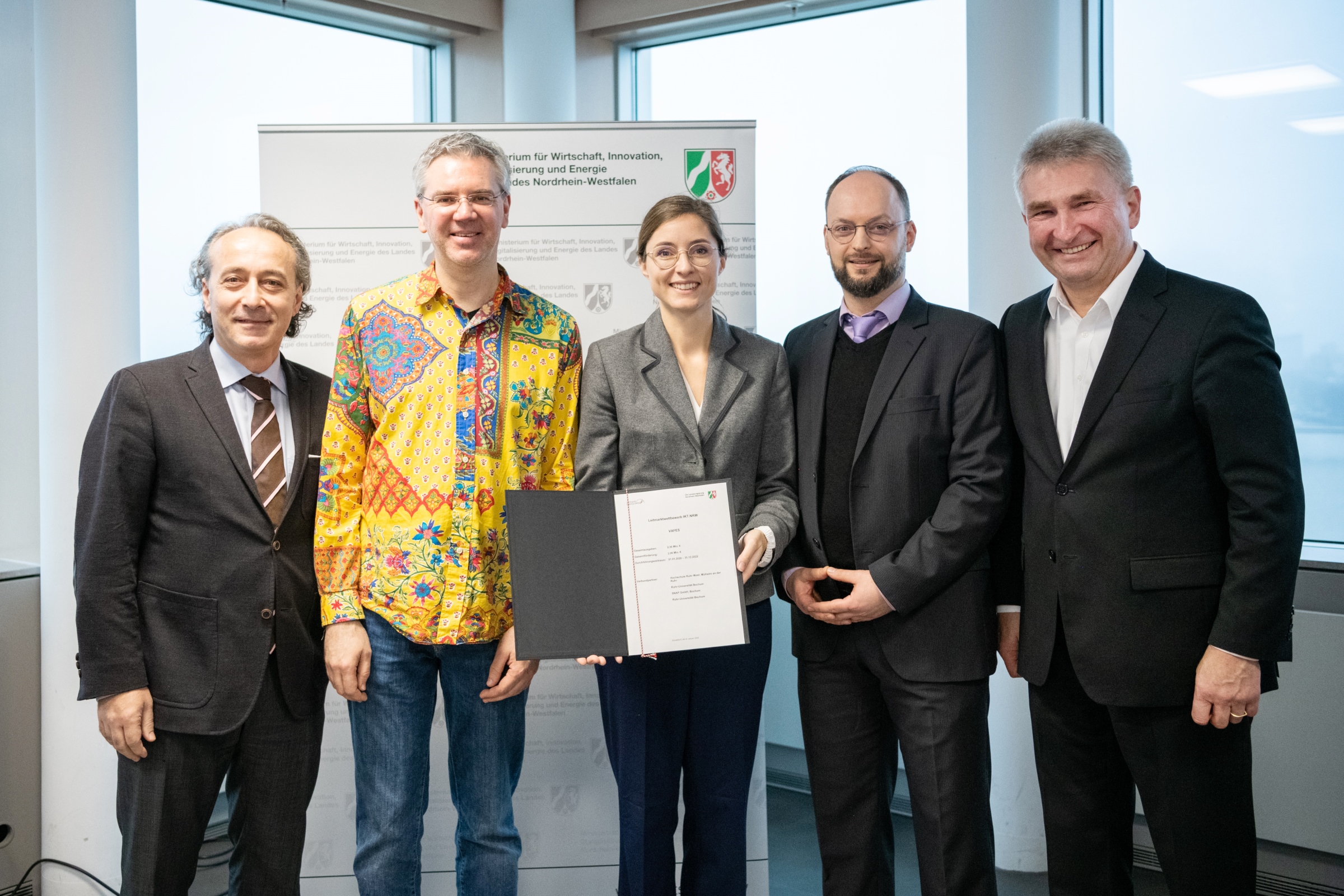
Wirtschafts- und Digitalminister Prof. Dr. Andreas Pinkwart (rechts) überreicht den Förderbescheid. V.l.: Prof. Dr. Ioannis Iossifidis (Hochschule Ruhr West, Bottrop), Dr. Christian Klaes (Universitätsklinikum Knappschaftskrankenhaus Bochum), Dr. Corinna Weber (SNAP GmbH, Bochum), Dr. Matthias Sczesny-Kaiser (BG Universitätsklinikum Bergmannsheil, Bochum) © MWIDE NRW / M.Hermenau
Mit einem neuen Testsystem wollen Forscher neurologische Bewegungsstörungen künftig schneller und sicherer diagnostizieren. Das Testsystem soll in der virtuellen Realität umgesetzt werden und intelligente Konzepte des maschinellen Lernens integrieren.

Für ihr Projekt VAFES (Virtueller Arm- und Handtest mit Hilfe von maschinellem Lernen bei neurologischen Bewegungsstörungen) erhält das Team in den nächsten drei Jahren eine Förderung von rund 2,4 Mio. Euro. Prof. Dr. Andreas Pinkwart, Minister für Wirtschaft und Digitalisierung des Landes NRW, übergab kürzlich den Förderbescheid.

Maschinelles Lernen für die Parkinson-Diagnostik nutzbar machen

Patienten mit neurologischen Erkrankungen oder Verletzungen leiden häufig unter einer stark eingeschränkten Funktion von Händen und Armen. Das betrifft beispielsweise Patienten mit einem Parkinson-Syndrom, aber auch Schlaganfall- oder rückenmarkverletzte Patienten. Die frühzeitige und zuverlässige Erkennung solcher Fehlfunktionen ist oft anspruchsvoll, und die etablierten Diagnostikverfahren sind mitunter nicht ausreichend.

Ein neues Testsystem soll Abhilfe schaffen. Dazu wollen die Forscher des Projektes VAFES einen Sensorhandschuh entwickeln, mit dem Patienten in einer virtuellen Realität standardisierte Bewegungsaufgaben lösen sollen. Die Bewegungsmuster, die dabei aufgenommen werden, werden mit Konzepten des maschinellen Lernens ausgewertet. Zusätzlich werden noch weitere Biosignale des Patienten in die Auswertung integriert. So wollen die Forscher künftig ein selbstlernendes System entwickeln, das eine zuverlässige Diagnose, Klassifikation und Therapiesteuerung von neurologisch bedingten Minderfunktionen von Händen und Armen bereitstellen kann.

Therapeutisch werden die gewonnen Erkenntnisse zur Behandlung von Muskelzittern (Tremor), zur Etablierung VR-gestützter Neurofeedback-Therapieansätze extrapyramidaler und zerebellärer Bewegungsstörungen und zur Feinkalibrierung der Tiefenhirnstimulation bei der Parkinsonbehandlung eingesetzt. Die entwickelten modularen Hard- und Software-Komponenten werden sowohl klinisch/wissenschaftlich (VR-Testumgebung) als auch wirtschaftlich (Testinstrument, Decoder, aktiver Sensorhandschuh) verwertet.

Projektpartner aus Wissenschaft, Klinik und Industrie

Das Institut Informatik der Hochschule Ruhr West übernimmt mit Prof. Dr. Ioannis Iossifidis die Rolle des Konsortialführers. Projektpartner sind das BG Universitätsklinikum Bergmannsheil Bochum, vertreten durch Dr. Matthias Sczesny-Kaiser von der Neurologischen Klinik, das Universitätsklinikum Knappschaftskrankenhaus Bochum, vertreten durch Dr. Christian Klaes, und die SNAP GmbH, vertreten durch Dr. Corinna Weber. Für ihr Vorhaben erhalten die Projektpartner für die nächsten drei Jahre eine Förderung aus Mitteln des europäischen Fonds für regionale Entwicklung (EFRE) und des Landes Nordrhein-Westfalen in Höhe von 2,36 Millionen Euro.

Über das Bergmannsheil

Das BG Universitätsklinikum Bergmannsheil zählt zu den größten Akutkliniken der Maximalversorgung im Ruhrgebiet. 1890 als erste Unfallklinik der Welt zur Versorgung verunglückter Bergleute begründet, vereint das Bergmannsheil heute 23 hochspezialisierte Kliniken und Fachabteilungen unter einem Dach. Rund 2.200 Mitarbeiter stellen die qualifizierte Versorgung von rund 84.000 Patienten pro Jahr sicher. 

Das BG Universitätsklinikum Bergmannsheil gehört zur Unternehmensgruppe der BG Kliniken. Die BG Kliniken sind spezialisiert auf die Akutversorgung und Rehabilitation schwerverletzter und berufserkrankter Menschen. In neun Akutkliniken, zwei Kliniken für Berufskrankheiten und zwei Ambulanzen versorgen über 13.000 Beschäftigte mehr als 560.000 Fälle pro Jahr. Träger der BG Kliniken sind die gewerblichen Berufsgenossenschaften und Unfallkassen. Weitere Informationen: www.bergmannsheil.de, www.bg-kliniken.de

Tags: press

Post navigation

❮ Previous Post: Projektteam um Prof. Dr. Ioannis Iossifidis (2. Reihe links) traf sich, um Arbeitspakete und Meilensteine zu besprechen
Next Post: Medica Magazin: Früherkennung von Parkinson mit VR und Sensoren ❯

Recent Posts

  • (no title) June 18, 2026
  • New journal article: Predicting Muscle Activity from Upper Limb Kinematics with LSTM Networks June 7, 2026
  • New preprint: The Spatial and Temporal Resolution of Motor Intention in Multi-Target Prediction June 7, 2026
  • New paper: Performance Boundaries for BCIs Using Error-Related Potentials and Reinforcement Learning June 7, 2026
  • New paper: Distributional Properties of ReLU-Activations in Neural Networks That Learn by Memorization June 7, 2026

Recent Comments

    Archives

    • June 2026
    • May 2026
    • October 2025
    • January 2025
    • October 2024
    • September 2024
    • September 2023
    • June 2023
    • December 2022
    • October 2022
    • September 2022
    • May 2022
    • February 2022
    • January 2022
    • November 2021
    • August 2021
    • June 2021
    • April 2021
    • March 2021
    • February 2021
    • December 2020
    • November 2020
    • October 2020
    • September 2020
    • September 2019
    • October 2018
    • December 2017
    • September 2017
    • July 2016
    • December 2015
    • November 2013
    • October 2013
    • August 2013
    • May 2013
    • July 2012
    • March 2012
    • February 2012
    • January 2012
    • December 2011
    • September 2011
    • March 2011
    • June 2010
    • May 2010
    • April 2010
    • March 2010
    • September 2009
    • July 2009
    • May 2009
    • April 2009
    • March 2009
    • February 2009

    Categories

    • Conference participation
    • Grant
    • invited talk
    • journal club
    • press release
    • progress club
    • publication
    • research grand
    • scientific publication
    • software released
    • teaching
    • workshop

    Meta

    • Log in
    • Entries feed
    • Comments feed
    • WordPress.org

    Copyright © Ioannis Iossifidis 2020 iLab: From Brain to Machine and Back.

    Theme: Oceanly by ScriptsTown

    We use cookies on our website to give you the most relevant experience by remembering your preferences and repeat visits. By clicking “Accept All”, you consent to the use of ALL the cookies. However, you may visit "Cookie Settings" to provide a controlled consent.
    Cookie SettingsAccept All
    Manage consent

    Privacy Overview

    This website uses cookies to improve your experience while you navigate through the website. Out of these, the cookies that are categorized as necessary are stored on your browser as they are essential for the working of basic functionalities of the website. We also use third-party cookies that help us analyze and understand how you use this website. These cookies will be stored in your browser only with your consent. You also have the option to opt-out of these cookies. But opting out of some of these cookies may affect your browsing experience.
    Necessary
    Always Enabled
    Necessary cookies are absolutely essential for the website to function properly. These cookies ensure basic functionalities and security features of the website, anonymously.
    CookieDurationDescription
    cookielawinfo-checkbox-analytics11 monthsThis cookie is set by GDPR Cookie Consent plugin. The cookie is used to store the user consent for the cookies in the category "Analytics".
    cookielawinfo-checkbox-functional11 monthsThe cookie is set by GDPR cookie consent to record the user consent for the cookies in the category "Functional".
    cookielawinfo-checkbox-functional11 monthsThe cookie is set by GDPR cookie consent to record the user consent for the cookies in the category "Functional".
    cookielawinfo-checkbox-necessary11 monthsThis cookie is set by GDPR Cookie Consent plugin. The cookies is used to store the user consent for the cookies in the category "Necessary".
    cookielawinfo-checkbox-necessary11 monthsThis cookie is set by GDPR Cookie Consent plugin. The cookies is used to store the user consent for the cookies in the category "Necessary".
    cookielawinfo-checkbox-others11 monthsThis cookie is set by GDPR Cookie Consent plugin. The cookie is used to store the user consent for the cookies in the category "Other.
    cookielawinfo-checkbox-performance11 monthsThis cookie is set by GDPR Cookie Consent plugin. The cookie is used to store the user consent for the cookies in the category "Performance".
    cookielawinfo-checkbox-performance11 monthsThis cookie is set by GDPR Cookie Consent plugin. The cookie is used to store the user consent for the cookies in the category "Performance".
    viewed_cookie_policy11 monthsThe cookie is set by the GDPR Cookie Consent plugin and is used to store whether or not user has consented to the use of cookies. It does not store any personal data.
    viewed_cookie_policy11 monthsThe cookie is set by the GDPR Cookie Consent plugin and is used to store whether or not user has consented to the use of cookies. It does not store any personal data.
    Functional
    Functional cookies help to perform certain functionalities like sharing the content of the website on social media platforms, collect feedbacks, and other third-party features.
    Performance
    Performance cookies are used to understand and analyze the key performance indexes of the website which helps in delivering a better user experience for the visitors.
    Analytics
    Analytical cookies are used to understand how visitors interact with the website. These cookies help provide information on metrics the number of visitors, bounce rate, traffic source, etc.
    Advertisement
    Advertisement cookies are used to provide visitors with relevant ads and marketing campaigns. These cookies track visitors across websites and collect information to provide customized ads.
    Others
    Other uncategorized cookies are those that are being analyzed and have not been classified into a category as yet.
    SAVE & ACCEPT