Skip to content
iLab: From Brain to Machine and Back

iLab: From Brain to Machine and Back

iossifidis Lab

  • Home
  • Research Projects
  • Publications
  • Software
  • Press and Media
  • Student’s Zone — Teaching
    • Thesis topics
    • Student Projects
    • Journal Club & Progress Club
    • Lab Course
    • Lectures – Vorlesungen
  • About us
    • The Team
    • Contact
    • Impressum
  • Home
  • 2022
  • September
  • 29
  • Bernstein Conference 2022: Linking muscle activity and motion trajectory
Bernstein Conference 2022: Linking muscle activity and motion trajectory

Bernstein Conference 2022: Linking muscle activity and motion trajectory

Posted on September 29, 2022September 29, 2022 By jannis
scientific publication
  • Marie Dominique Schmidt1 , Ioannis Iossifidis1
  1. Institute of Computer Science, University of Applied Science Ruhr West, Duisburger Str. 100, 45479 Mülheim an der Ruhr, Germany
191_MarieDominiqueSchmidtDownload

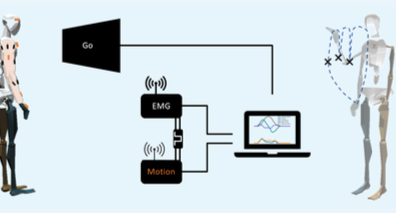
The upper limbs enable us to perform a variety of tasks in everyday life that require strength and a wide range of motion as well as precision. For coordinated motion, the action must be well planned and timed. Therefore, information about the target and the current body state from the sensory systems is as important as the integration of previous experiences. These experiences might be represented as pre-learned inverse dynamics that generate associated muscle activity. We propose a generative model that predicts the upper limb muscle activity driven by various motion parameters. The generative model is based on a recurrent neural network predicting muscle activity or complex upper limb motions. Our approach achieves remarkable agreement in predicting different subjects and abstracts well for new motions and muscle activities that have not been trained before. The high inter-subject variation of the recorded muscle activity is successfully handled using a transfer learning approach, resulting in a good fit for a new subject.

To gain a deeper understanding of the link between motion trajectory and muscle activity, we reverse our problem and test the opposite prediction from muscle activity to motion parameters. The ability of this approach to predict muscle activity and motion trajectory efficiently has implications for the fundamental understanding of movement control and use for rehabilitation of neuromuscular diseases with myoelectric prostheses and functional electrical stimulation.

Post navigation

❮ Previous Post: Bernstein Conference 2022: Exploring Distribution Parameterizations for Distributional Continuous Control
Next Post: Bernstein Conference 2022:Closed-loop adaptation of brain-machine interfaces using error-related potentials and reinforcement learning ❯

Recent Posts

  • (no title) June 18, 2026
  • New journal article: Predicting Muscle Activity from Upper Limb Kinematics with LSTM Networks June 7, 2026
  • New preprint: The Spatial and Temporal Resolution of Motor Intention in Multi-Target Prediction June 7, 2026
  • New paper: Performance Boundaries for BCIs Using Error-Related Potentials and Reinforcement Learning June 7, 2026
  • New paper: Distributional Properties of ReLU-Activations in Neural Networks That Learn by Memorization June 7, 2026

Recent Comments

    Archives

    • June 2026
    • May 2026
    • October 2025
    • January 2025
    • October 2024
    • September 2024
    • September 2023
    • June 2023
    • December 2022
    • October 2022
    • September 2022
    • May 2022
    • February 2022
    • January 2022
    • November 2021
    • August 2021
    • June 2021
    • April 2021
    • March 2021
    • February 2021
    • December 2020
    • November 2020
    • October 2020
    • September 2020
    • September 2019
    • October 2018
    • December 2017
    • September 2017
    • July 2016
    • December 2015
    • November 2013
    • October 2013
    • August 2013
    • May 2013
    • July 2012
    • March 2012
    • February 2012
    • January 2012
    • December 2011
    • September 2011
    • March 2011
    • June 2010
    • May 2010
    • April 2010
    • March 2010
    • September 2009
    • July 2009
    • May 2009
    • April 2009
    • March 2009
    • February 2009

    Categories

    • Conference participation
    • Grant
    • invited talk
    • journal club
    • press release
    • progress club
    • publication
    • research grand
    • scientific publication
    • software released
    • teaching
    • workshop

    Meta

    • Log in
    • Entries feed
    • Comments feed
    • WordPress.org

    Copyright © Ioannis Iossifidis 2020 iLab: From Brain to Machine and Back.

    Theme: Oceanly by ScriptsTown

    We use cookies on our website to give you the most relevant experience by remembering your preferences and repeat visits. By clicking “Accept All”, you consent to the use of ALL the cookies. However, you may visit "Cookie Settings" to provide a controlled consent.
    Cookie SettingsAccept All
    Manage consent

    Privacy Overview

    This website uses cookies to improve your experience while you navigate through the website. Out of these, the cookies that are categorized as necessary are stored on your browser as they are essential for the working of basic functionalities of the website. We also use third-party cookies that help us analyze and understand how you use this website. These cookies will be stored in your browser only with your consent. You also have the option to opt-out of these cookies. But opting out of some of these cookies may affect your browsing experience.
    Necessary
    Always Enabled
    Necessary cookies are absolutely essential for the website to function properly. These cookies ensure basic functionalities and security features of the website, anonymously.
    CookieDurationDescription
    cookielawinfo-checkbox-analytics11 monthsThis cookie is set by GDPR Cookie Consent plugin. The cookie is used to store the user consent for the cookies in the category "Analytics".
    cookielawinfo-checkbox-functional11 monthsThe cookie is set by GDPR cookie consent to record the user consent for the cookies in the category "Functional".
    cookielawinfo-checkbox-functional11 monthsThe cookie is set by GDPR cookie consent to record the user consent for the cookies in the category "Functional".
    cookielawinfo-checkbox-necessary11 monthsThis cookie is set by GDPR Cookie Consent plugin. The cookies is used to store the user consent for the cookies in the category "Necessary".
    cookielawinfo-checkbox-necessary11 monthsThis cookie is set by GDPR Cookie Consent plugin. The cookies is used to store the user consent for the cookies in the category "Necessary".
    cookielawinfo-checkbox-others11 monthsThis cookie is set by GDPR Cookie Consent plugin. The cookie is used to store the user consent for the cookies in the category "Other.
    cookielawinfo-checkbox-performance11 monthsThis cookie is set by GDPR Cookie Consent plugin. The cookie is used to store the user consent for the cookies in the category "Performance".
    cookielawinfo-checkbox-performance11 monthsThis cookie is set by GDPR Cookie Consent plugin. The cookie is used to store the user consent for the cookies in the category "Performance".
    viewed_cookie_policy11 monthsThe cookie is set by the GDPR Cookie Consent plugin and is used to store whether or not user has consented to the use of cookies. It does not store any personal data.
    viewed_cookie_policy11 monthsThe cookie is set by the GDPR Cookie Consent plugin and is used to store whether or not user has consented to the use of cookies. It does not store any personal data.
    Functional
    Functional cookies help to perform certain functionalities like sharing the content of the website on social media platforms, collect feedbacks, and other third-party features.
    Performance
    Performance cookies are used to understand and analyze the key performance indexes of the website which helps in delivering a better user experience for the visitors.
    Analytics
    Analytical cookies are used to understand how visitors interact with the website. These cookies help provide information on metrics the number of visitors, bounce rate, traffic source, etc.
    Advertisement
    Advertisement cookies are used to provide visitors with relevant ads and marketing campaigns. These cookies track visitors across websites and collect information to provide customized ads.
    Others
    Other uncategorized cookies are those that are being analyzed and have not been classified into a category as yet.
    SAVE & ACCEPT