
Publications
2026
Marie D. Schmidt; Ioannis Iossifidis
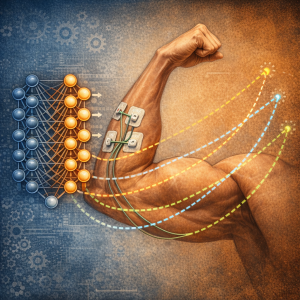
The Spatial and~Temporal Resolution of~Motor Intention in~Multi-target Prediction Inproceedings
In: Neumann, Philipp; Puma, Michael J.; Lees, Michael H.; Groen, Derek; Dongarra, Jack J.; Sloot, Peter M. A. (Ed.): Computational Science – ICCS 2026, pp. 421–428, Springer Nature Switzerland, Cham, 2026, ISBN: 978-3-032-29924-6.
Abstract | Links | BibTeX | Tags: BCI, EMG, HMI, Motor control, Random Forest
@inproceedings{schmidtSpatialTemporalResolution2026,

title = {The Spatial and~Temporal Resolution of~Motor Intention in~Multi-target Prediction},

author = {Marie D. Schmidt and Ioannis Iossifidis},

editor = {Philipp Neumann and Michael J. Puma and Michael H. Lees and Derek Groen and Jack J. Dongarra and Peter M. A. Sloot},

doi = {10.1007/978-3-032-29924-6_36},

isbn = {978-3-032-29924-6},

year  = {2026},

date = {2026-06-27},

urldate = {2026-06-27},

booktitle = {Computational Science – ICCS 2026},

pages = {421–428},

publisher = {Springer Nature Switzerland},

address = {Cham},

abstract = {Reaching, grasping, and object manipulation are essential motor functions in everyday life. This study predicts movement direction and target location from multichannel electromyography (EMG) signals, examining how spatially and temporally accurate intentions can be detected relative to movement onset. A computational pipeline combining data-driven temporal segmentation with Random Forest model is applied to EMG data across planning, execution, and contact phases of a reaching task.},

keywords = {BCI, EMG, HMI, Motor control, Random Forest},

pubstate = {published},

tppubtype = {inproceedings}

}
Felix Grün; Muhammad Saif-ur-Rehman; Tobias Glasmachers; Ioannis Iossifidis
Invariance to~Quantile Selection in~Distributional Continuous Control Inproceedings
In: Nicosia, Giuseppe; Ojha, Varun; Giesselbach, Sven; Pardalos, M. Panos; Umeton, Renato; Emanuele, La Malfa; Gabriele, La Malfa (Ed.): Machine Learning, Optimization, and Data Science, pp. 175–190, Springer Nature Switzerland, Cham, 2026, ISBN: 978-3-032-21477-5.
Abstract | Links | BibTeX | Tags: Actor-critic, BCI, Continuous control, Distributional reinforcement learning, Machine Learning, Quantile regression, reinforcement learning (RL)
@inproceedings{grunInvarianceQuantileSelection2026,

title = {Invariance to~Quantile Selection in~Distributional Continuous Control},

author = {Felix Grün and Muhammad Saif-ur-Rehman and Tobias Glasmachers and Ioannis Iossifidis},

editor = {Giuseppe Nicosia and Varun Ojha and Sven Giesselbach and M. Panos Pardalos and Renato Umeton and La Malfa Emanuele and La Malfa Gabriele},

doi = {10.1007/978-3-032-21477-5_12},

isbn = {978-3-032-21477-5},

year  = {2026},

date = {2026-06-01},

urldate = {2026-06-01},

booktitle = {Machine Learning, Optimization, and Data Science},

pages = {175–190},

publisher = {Springer Nature Switzerland},

address = {Cham},

abstract = {In recent years, distributional reinforcement learning has produced many state-of-the-art results in typical reinforcement learning benchmarks, such as the suite of Atari games. Increasingly sample-efficient distributional algorithms for the discrete action domain have been developed over time, which vary primarily in the way they parameterize their approximations of value distributions, and how they quantify the differences between those distributions. In this work, we transfer three of those algorithms - Quantile Regression Deep Q-Network (QR-DQN), Implicit Quantile Networks (IQN) and Fully Parameterized Quantile Function (FQF) - to the continuous action domain by extending two powerful actor-critic algorithms - Twin Delayed Deep Deterministic policy gradient (TD3) and Soft Actor-Critic (SAC) - with distributional critics. We investigate whether the relative performance of the methods for the discrete action space translates to the continuous case. To that end, we compare them empirically on a set of continuous control tasks (Ant, HalfCheetah, Hopper, Humanoid and Walker2D). Our results indicate qualitative invariance regarding the number and placement of distributional atoms in the deterministic, continuous action setting.},

keywords = {Actor-critic, BCI, Continuous control, Distributional reinforcement learning, Machine Learning, Quantile regression, reinforcement learning (RL)},

pubstate = {published},

tppubtype = {inproceedings}

}
Stephan Johann Lehmler; Muhammad Saif-ur-Rehman; Tobias Glasmachers; Ioannis Iossifidis
Distributional Properties of~ReLU-Activations in~Artificial Neural Networks That~Learn by~Memorization Inproceedings
In: Nicosia, Giuseppe; Ojha, Varun; Giesselbach, Sven; Pardalos, M. Panos; Umeton, Renato; Emanuele, La Malfa; Gabriele, La Malfa (Ed.): Machine Learning, Optimization, and Data Science, pp. 410–423, Springer Nature Switzerland, Cham, 2026, ISBN: 978-3-032-21477-5.
Abstract | Links | BibTeX | Tags: Artificial neural networks, BCI, Machine Learning, Memorization, Statistical Modeling
@inproceedings{lehmlerDistributionalPropertiesReLUActivations2026,

title = {Distributional Properties of~ReLU-Activations in~Artificial Neural Networks That~Learn by~Memorization},

author = {Stephan Johann Lehmler and Muhammad Saif-ur-Rehman and Tobias Glasmachers and Ioannis Iossifidis},

editor = {Giuseppe Nicosia and Varun Ojha and Sven Giesselbach and M. Panos Pardalos and Renato Umeton and La Malfa Emanuele and La Malfa Gabriele},

doi = {10.1007/978-3-032-21477-5_27},

isbn = {978-3-032-21477-5},

year  = {2026},

date = {2026-06-01},

urldate = {2026-06-01},

booktitle = {Machine Learning, Optimization, and Data Science},

pages = {410–423},

publisher = {Springer Nature Switzerland},

address = {Cham},

abstract = {We investigate the distributional properties of layers in Artificial Neural Network (ANN) that can be used to distinguish between networks learning by generalization and memorizing networks. Starting from the notion of memorization being essentially definable as learning ‘rare’ features of the input data, we propose the activation probability of Rectified Linear Units (ReLU)-neurons as an important indicator of memorization. Building on this idea, we show how hypotheses about distributional properties over whole networks structures can be derived from the activation probability of singular neurons in memorizing ANNs. We such extend previous work on using Poisson process models of activations in ANN by considering the correlation between neurons. Using this approach, we further simulate the effect of memorizing neurons on distributional properties of weight matrices and activation magnitudes and find a connection between L1/L2-norm regularization of weight matrices. We empirically evaluate the distributions of activation rate, correlation structure and weight matrices in memorizing and generalizing ANNs on a simple MNIST-classification task. Our initial findings show how the activation frequency and intra-layer correlation structure can be used to distinguish generalizing from memorizing networks and for inferring distributional properties on affected parts of the networks. This work presents a building block to later derive online metrics for memorization in ANNs.},

keywords = {Artificial neural networks, BCI, Machine Learning, Memorization, Statistical Modeling},

pubstate = {published},

tppubtype = {inproceedings}

}
Aline Xavier Fidêncio; Felix Grün; Christian Klaes; Ioannis Iossifidis
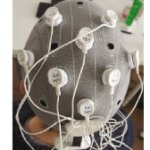
Performance Boundaries for~Brain-Computer Interfaces Using Error-Related Potentials and~Reinforcement Learning Inproceedings
In: Nicosia, Giuseppe; Ojha, Varun; Giesselbach, Sven; Pardalos, M. Panos; Umeton, Renato; Emanuele, La Malfa; Gabriele, La Malfa (Ed.): Machine Learning, Optimization, and Data Science, pp. 335–349, Springer Nature Switzerland, Cham, 2026, ISBN: 978-3-032-21480-5.
Abstract | Links | BibTeX | Tags: adaptive brain-computer interface, BCI, electroencephalography (EEG), error-related potentials (ErrPs), Machine Learning, motor imagery (MI), reinforcement learning (RL)
@inproceedings{xavierfidencioPerformanceBoundariesBrainComputer2026,

title = {Performance Boundaries for~Brain-Computer Interfaces Using Error-Related Potentials and~Reinforcement Learning},

author = {Aline Xavier Fidêncio and Felix Grün and Christian Klaes and Ioannis Iossifidis},

editor = {Giuseppe Nicosia and Varun Ojha and Sven Giesselbach and M. Panos Pardalos and Renato Umeton and La Malfa Emanuele and La Malfa Gabriele},

doi = {10.1007/978-3-032-21480-5_23},

isbn = {978-3-032-21480-5},

year  = {2026},

date = {2026-06-01},

urldate = {2026-06-01},

booktitle = {Machine Learning, Optimization, and Data Science},

pages = {335–349},

publisher = {Springer Nature Switzerland},

address = {Cham},

abstract = {Non-invasive brain-computer interfaces (BCIs) can improve quality of life for individuals with motor disabilities. However, input data non-stationarity often leads to performance degradation over time. Adaptive BCIs aim to address this challenge. Recent studies have proposed leveraging error-related potentials (ErrPs) - neural signals elicited during self-made or observed errors - as a natural feedback mechanism for closed-loop systems. While these approaches demonstrate potential performance gains, their effectiveness relies heavily on accurate ErrP detection, which remains challenging. In a previous study, we introduced a novel reinforcement learning-based BCI framework incorporating ErrPs as reward signals. We systematically examine how misclassification rates in ErrP detection in terms of false positives (FPs) and false negatives (FNs) influence closed-loop performance. We use both synthetic and real datasets to evaluate two contextual bandit algorithms (LinUCB and NeuralUCB), trained to map motor imagery-related time-frequency modulations to actions in a binary task. Firstly, our findings show that the sensitivity of agents to FPs and FNs depends on baseline accuracies. In some conditions, such as insufficient exploration, false negatives might be more detrimental than false positives, but this needs further investigation. Proper agent parametrization and enough data samples can compensate the negative effects to some extent.},

keywords = {adaptive brain-computer interface, BCI, electroencephalography (EEG), error-related potentials (ErrPs), Machine Learning, motor imagery (MI), reinforcement learning (RL)},

pubstate = {published},

tppubtype = {inproceedings}

}
Marie Dominique Schmidt; Ioannis Iossifidis
The Spatial and Temporal Resolution of Motor Intention in Multi-Target Prediction Journal Article
In: arXiv:2603.05418 [q-bio.NC], 2026.
Abstract | Links | BibTeX | Tags: BCI, Machine Learning, Motor control
@article{schmidt2026spatialtemporalresolutionmotor,

title = {The Spatial and Temporal Resolution of Motor Intention in Multi-Target Prediction},

author = {Marie Dominique Schmidt and Ioannis Iossifidis},

url = {https://arxiv.org/abs/2603.05418},

doi = {https://doi.org/10.48550/arXiv.2603.05418},

year  = {2026},

date = {2026-03-05},

urldate = {2026-03-05},

journal = {arXiv:2603.05418 [q-bio.NC]},

abstract = {Reaching for grasping, and manipulating objects are essential motor functions in everyday life. Decoding human motor intentions is a central challenge for rehabilitation and assistive technologies. This study focuses on predicting intentions by inferring movement direction and target location from multichannel electromyography (EMG) signals, and investigating how spatially and temporally accurate such information can be detected relative to movement onset. We present a computational pipeline that combines data-driven temporal segmentation with classical and deep learning classifiers in order to analyse EMG data recorded during the planning, early execution, and target contact phases of a delayed reaching task.

Early intention prediction enables devices to anticipate user actions, improving responsiveness and supporting active motor recovery in adaptive rehabilitation systems. Random Forest achieves 80% accuracy and Convolutional Neural Network 75% accuracy across 25 spatial targets, each separated by 14∘ azimuth/altitude. Furthermore, a systematic evaluation of EMG channels, feature sets, and temporal windows demonstrates that motor intention can be efficiently decoded even with drastically reduced data. This work sheds light on the temporal and spatial evolution of motor intention, paving the way for anticipatory control in adaptive rehabilitation systems and driving advancements in computational approaches to motor neuroscience.},

keywords = {BCI, Machine Learning, Motor control},

pubstate = {published},

tppubtype = {article}

}
Early intention prediction enables devices to anticipate user actions, improving responsiveness and supporting active motor recovery in adaptive rehabilitation systems. Random Forest achieves 80% accuracy and Convolutional Neural Network 75% accuracy across 25 spatial targets, each separated by 14∘ azimuth/altitude. Furthermore, a systematic evaluation of EMG channels, feature sets, and temporal windows demonstrates that motor intention can be efficiently decoded even with drastically reduced data. This work sheds light on the temporal and spatial evolution of motor intention, paving the way for anticipatory control in adaptive rehabilitation systems and driving advancements in computational approaches to motor neuroscience.
Marie D. Schmidt; Tobias Glasmachers; Ioannis Iossifidis
Insights into Motor Control: Predict Muscle Activity from Upper Limb Kinematics with LSTM Networks Journal Article
In: Nature Scientific Reports, 2026, ISSN: 2045-2322.
Abstract | Links | BibTeX | Tags: BCI, Computational biology and bioinformatics, Motor control, Neuroscience
@article{schmidtInsightsMotorControl2026,

title = {Insights into Motor Control: Predict Muscle Activity from Upper Limb Kinematics with LSTM Networks},

author = {Marie D. Schmidt and Tobias Glasmachers and Ioannis Iossifidis},

editor = {Nature Publishing Group},

url = {https://www.nature.com/articles/s41598-025-33696-y},

doi = {10.1038/s41598-025-33696-y},

issn = {2045-2322},

year  = {2026},

date = {2026-01-05},

urldate = {2026-01-05},

journal = {Nature Scientific Reports},

publisher = {Nature Publishing Group},

abstract = {This study explores the relationship between upper limb kinematics and corresponding muscle activity, aiming to understand how predictive models can approximate motor control. We employ a Long Short-Term Memory (LSTM) network trained on kinematic end effector data to estimate muscle activity for eight muscles. The model exhibits strong predictive accuracy for new repetitions of known movements and generalizes to unseen movements, suggesting it captures underlying biomechanical principles rather than merely memorizing patterns. This generalization is particularly valuable for applications in rehabilitation and human-machine interaction, as it reduces the need for exhaustive datasets. To further investigate movement representation and learning, we analyze the impact of motion segmentation, hypothesizing that breaking movements into simpler components may improve model performance. Additionally, we explore the role of the swivel angle in reducing redundancy in arm kinematics. Another key focus is the effect of training data complexity on generalization. Specifically, we assess whether training on a diverse set of movements leads to better performance than specializing in either simple, single-joint movements or complex, multi-joint movements. The study is based on an experimental setup involving 23 distinct upper limb movements performed by five subjects. Our findings provide insights into the interplay between kinematics and muscle activity, contributing to motor control research and advancing neural network-based movement prediction.},

keywords = {BCI, Computational biology and bioinformatics, Motor control, Neuroscience},

pubstate = {published},

tppubtype = {article}

}
2025
Marie Dominique Schmidt; Ioannis Iossifidis
Predicting Upper Limb Muscle Activity from Kinematics Using LSTM Networks Inproceedings
In: Bernstein Conference 2025, BCCN Bernstein Network Computational Neuroscience & Neurotechnology, 2025.
Abstract | Links | BibTeX | Tags: BCI
@inproceedings{schmidtPredictingUpperLimb2025,

title = {Predicting Upper Limb Muscle Activity from Kinematics Using LSTM Networks},

author = {Marie Dominique Schmidt and Ioannis Iossifidis},

url = {https://abstracts.g-node.org/conference/BC25/abstracts#/uuid/a8fa799f-bf8e-4192-8ba9-3b1e3ad078ea},

year  = {2025},

date = {2025-10-01},

urldate = {2025-10-01},

booktitle = {Bernstein Conference 2025},

publisher = {BCCN Bernstein Network Computational Neuroscience & Neurotechnology},

abstract = {The upper limbs are essential for performing everyday tasks that require a wide range of motion and precise coordination. Planning and timing are crucial to achieve coordinated movement. Sensory information about the target and current body state is critical, as is the integration of prior experience represented by prelearned inverse dynamics that generate the associated muscle activity. We propose a generative model that uses a recurrent neural network to predict upper limb muscle activity during various simple and complex everyday movements. By identifying movement primitives within the signal, our model enables the decomposition of these movements into a fundamental set, facilitating the reconstruction of muscle activity patterns. Our approach has implications for the fundamental understanding of movement control and the rehabilitation of neuromuscular disorders with myoelectric prosthetics and functional electrical stimulation.},

keywords = {BCI},

pubstate = {published},

tppubtype = {inproceedings}

}
Aline Xavier Fidencio; Ioannis Iossifidis
Error-Related Potentials and Reinforcement Learning for Neuroadaptive Systems Inproceedings
In: BC25 : Bernstein Conference 2025,, BCCN Bernstein Network Computational Neuroscience & Neurotechnology, 2025.
Abstract | Links | BibTeX | Tags: BCI, Machine Learning
@inproceedings{xavierfidencioErrorrelatedPotentialsReinforcement2025,

title = {Error-Related Potentials and Reinforcement Learning for Neuroadaptive Systems},

author = {Aline Xavier Fidencio and Ioannis Iossifidis},

url = {https://abstracts.g-node.org/conference/BC25/abstracts#/uuid/84a56344-585c-4d7c-992d-1f34489770f5},

year  = {2025},

date = {2025-10-01},

urldate = {2025-10-01},

booktitle = {BC25 : Bernstein Conference 2025,},

publisher = {BCCN Bernstein Network Computational Neuroscience & Neurotechnology},

abstract = {Error-related potentials (ErrPs) represent the neural signature of error processing in the brain and numerous studies have demonstrated their reliable detection using non-invasive techniques such as electroencephalography (EEG). Over recent decades, the brain-computer interface (BCI) community has shown growing interest in leveraging these intrinsic feedback signals to enhance system performance. However, the effective use of ErrPs in a closed-loop setup crucially depends on accurate single-trial detection, which is typically achieved using a subject-specific classifier (or decoder) trained on samples recorded during extensive calibration sessions before the BCI system can be deployed. In our research, we explore the potential of simulated EEG data for training a truly generic ErrP classifier. Utilizing the SEREEGA simulator, we demonstrate that EEG data can be generated in a cost-effective manner, allowing for controlled and systematic variations in data distribution to accommodate uncertainties in ErrP generation. A classifier trained solely on the generated data exhibits promising generalization capabilities across different datasets and performs comparably to a leave-one-subject-out approach trained on real data (Xavier Fidêncio et al., 2024). In our experiments, we deliberately provoked ErrPs when the BCI misinterpreted the user's intention, resulting in incorrect actions. Subjects engaged in a game controlled via keyboard and/or motor imagery (imagining hand movements), with EEG data recorded using various EEG systems for comparison. Considering the challenges in obtaining clear ErrP signals for all subjects and the limitations identified in existing literature (Xavier Fidêncio et al., 2022), we hypothesize whether a measurable error signal is consistently generated at the scalp level when subjects encounter erroneous conditions, and how this influences closed-loop setups that incorporate ErrPs for improved BCI performance. To address these questions, we assess the effects of the occurrence-to-detection ratio of ErrPs in the classification pipeline using simulated data and explore the impact of error misclassification rates in an ErrP-based learning framework, which employs reinforcement learning to enhance BCI performance.},

keywords = {BCI, Machine Learning},

pubstate = {published},

tppubtype = {inproceedings}

}

Felix Grün; Ioannis Iossifidis
A Framework to Model Your Model Based / Model Free Action Selection Hypothesis Inproceedings
In: BC25 : Bernstein Conference 2025,, BCCN Bernstein Network Computational Neuroscience & Neurotechnology, 2025.
Abstract | Links | BibTeX | Tags: BCI, Machine Learning, Reinforcement learning
@inproceedings{grunFrameworkModelYour2025,

title = {A Framework to Model Your Model Based / Model Free Action Selection Hypothesis},

author = {Felix Grün and Ioannis Iossifidis},

url = {https://abstracts.g-node.org/conference/BC25/abstracts#/uuid/e3090016-2d82-4107-b587-1474f97be0b3},

year  = {2025},

date = {2025-10-01},

urldate = {2025-10-01},

booktitle = {BC25 : Bernstein Conference 2025,},

publisher = {BCCN Bernstein Network Computational Neuroscience & Neurotechnology},

abstract = {Dopaminergic Reward Prediction Errors (RPEs) are a key motivation and inspiration for model free, temporal difference reinforcement learning methods. Originally, the correlation of RPEs with model free temporal difference errors was seen as a strong indicator for model free reinforcement learning in brains. The standard view was that model free learning is the norm and more computationally expensive model based decision-making is only used when it leads to outcomes that are good enough to justify the additional effort. Nowadays, the landscape of opinions, models and experimental evidence, both electrophysiological and behavioral, paints a more complex picture, including but not limited to mechanisms of arbitration between the two systems. Model based learning or hybrid models better capture experimental behavioral data, and model based signatures are found in RPEs that were previously thought to be model free or hybrid [1]. The evidence for clearly model free learning is scarce [2]. On the other hand, multiple approaches show how model based behavior and RPEs can be produced with fundamentally model free reinforcement learning methods [3, 4, 5]. We point out findings that seem to contradict each other, others that complement each other, speculate which ideas are compatible with each other and give our opinions on ways forward, towards understanding if and how model based and model free learning from rewards coexist and interact in the brain.},

keywords = {BCI, Machine Learning, Reinforcement learning},

pubstate = {published},

tppubtype = {inproceedings}

}
Muhammad Saif-ur-Rehman; Omair Ali; Christian Klaes; Ioannis Iossifidis
Adaptive SpikeDeep-classifier: Self-organizing and Self-Supervised Machine Learning Algorithm for Online Spike Sorting Journal Article
In: Neurocomputing, pp. 131370, 2025, ISSN: 0925-2312.
Abstract | Links | BibTeX | Tags: BCI, Brain computer interface, Deep learning, Self organizing, Self-supervised machine learning, Spike Sorting
@article{saif-ur-rehmanAdaptiveSpikeDeepclassifierSelforganizing2025,

title = {Adaptive SpikeDeep-classifier: Self-organizing and Self-Supervised Machine Learning Algorithm for Online Spike Sorting},

author = {Muhammad Saif-ur-Rehman and Omair Ali and Christian Klaes and Ioannis Iossifidis},

editor = {Elsevier},

url = {https://www.sciencedirect.com/science/article/pii/S0925231225020429},

doi = {10.1016/j.neucom.2025.131370},

issn = {0925-2312},

year  = {2025},

date = {2025-09-04},

urldate = {2025-09-04},

journal = {Neurocomputing},

pages = {131370},

abstract = {Objective. Invasive brain-computer interface (BCI) research is progressing towards the realization of the motor skills rehabilitation of severely disabled patients in the real world. The size of invasive micro-electrode arrays and the selection of an efficient online spike sorting algorithm (performing spike sorting at run time) are two key factors that play pivotal roles in the successful decoding of the user’s intentions. The process of spike sorting includes the selection of channels that record the spike activity (SA) and determines the SA of different sources (neurons), on selected channels individually. The neural data recorded with dense micro-electrode arrays is time-varying and often contaminated with non-stationary noise. Unfortunately, current state-of-the-art spike sorting algorithms are incapable of handling the massively increasing amount of time-varying data resulting from the dense microelectrode arrays, which makes the spike sorting one of the fragile components of the online BCI decoding framework. Approach. This study proposed an adaptive and self-organized algorithm for online spike sorting, named as Adaptive SpikeDeep-Classifier (Ada-SpikeDeepClassifier). Our algorithm uses SpikeDeeptector for the channel selection, an adaptive background activity rejector (Ada-BAR) for discarding the background events, and an adaptive spike deep-classifier (Ada-SpikeDeepClassifier) for classifying the SA of different neural units. The process of spike sorting is accomplished by concatenating SpikeDeeptector, Ada-BAR and Ada-SpikeDeepclassifier. Results. The proposed algorithm is evaluated on two different categories of data: a human data-set recorded in our lab, and a publicly available simulated data-set to avoid subjective biases and labeling errors. The proposed Ada-SpikeDeepClassifier outperformed our previously published SpikeDeep-Classifier and eight conventional spike sorting algorithms and produce comparable results to state of the art deep learning based algorithms. Significance. To the best of our knowledge, the proposed algorithm is the first spike sorting algorithm that autonomously adapts to the shift in the distribution of noise and SA data and perform spike sorting without human interventions in various kinds of experimental settings. In addition, the proposed algorithm builds upon artificial neural networks, which makes it an ideal candidate for being embedded on neuromorphic chips that are also suitable for wearable invasive BCI.},

keywords = {BCI, Brain computer interface, Deep learning, Self organizing, Self-supervised machine learning, Spike Sorting},

pubstate = {published},

tppubtype = {article}

}
Aline Xavier Fidêncio; Felix Grün; Christian Klaes; Ioannis Iossifidis
Hybrid Brain-Computer Interface Using Error-Related Potential and Reinforcement Learning Journal Article
In: Frontiers in Human Neuroscience, vol. 19, 2025, ISSN: 1662-5161.
Abstract | Links | BibTeX | Tags: adaptive brain-computer interface, BCI, EEG, error-related potentials (ErrPs), Machine Learning, motor imagery (MI), reinforcement learning (RL)
@article{xavierfidencioHybridBraincomputerInterface2025,

title = {Hybrid Brain-Computer Interface Using Error-Related Potential and Reinforcement Learning},

author = {Aline Xavier Fidêncio and Felix Grün and Christian Klaes and Ioannis Iossifidis},

editor = {Frontiers},

url = {https://www.frontiersin.org/journals/human-neuroscience/articles/10.3389/fnhum.2025.1569411/full},

doi = {10.3389/fnhum.2025.1569411},

issn = {1662-5161},

year  = {2025},

date = {2025-06-04},

urldate = {2025-06-04},

journal = {Frontiers in Human Neuroscience},

volume = {19},

publisher = {Frontiers},

abstract = {Brain-computer interfaces (BCIs) offer alternative communication methods for individuals with motor disabilities, aiming to improve their quality of life through external device control. However, non-invasive BCIs using electroencephalography (EEG) often suffer from performance limitations due to non-stationarities arising from changes in mental state or device characteristics. Addressing these challenges motivates the development of adaptive systems capable of real-time adjustment. This study investigates a novel approach for creating an adaptive, error-related potential (ErrP)-based BCI using reinforcement learning (RL) to dynamically adapt to EEG signal variations. The framework was validated through experiments on a publicly available motor imagery dataset and a novel fast-paced protocol designed to enhance user engagement. Results showed that RL agents effectively learned control policies from user interactions, maintaining robust performance across datasets. However, findings from the game-based protocol revealed that fast-paced motor imagery tasks were ineffective for most participants, highlighting critical challenges in real-time BCI task design. Overall, the results demonstrate the potential of RL for enhancing BCI adaptability while identifying practical constraints in task complexity and user responsiveness.},

keywords = {adaptive brain-computer interface, BCI, EEG, error-related potentials (ErrPs), Machine Learning, motor imagery (MI), reinforcement learning (RL)},

pubstate = {published},

tppubtype = {article}

}
Aline Xavier Fidêncio; Felix Grün; Christian Klaes; Ioannis Iossifidis
Error-Related Potential Driven Reinforcement Learning for Adaptive Brain-Computer Interfaces Journal Article
In: Arxiv, 2025.
Abstract | Links | BibTeX | Tags: BCI, Computer Science - Human-Computer Interaction, Computer Science - Machine Learning, EEG, Quantitative Biology - Neurons and Cognition, Reinforcement learning
@article{fidencioErrorrelatedPotentialDriven2025,

title = {Error-Related Potential Driven Reinforcement Learning for Adaptive Brain-Computer Interfaces},

author = {Aline Xavier Fidêncio and Felix Grün and Christian Klaes and Ioannis Iossifidis},

url = {http://arxiv.org/abs/2502.18594},

doi = {10.48550/arXiv.2502.18594},

year  = {2025},

date = {2025-02-25},

urldate = {2025-02-25},

journal = {Arxiv},

abstract = {Brain-computer interfaces (BCIs) provide alternative communication methods for individuals with motor disabilities by allowing control and interaction with external devices. Non-invasive BCIs, especially those using electroencephalography (EEG), are practical and safe for various applications. However, their performance is often hindered by EEG non-stationarities, caused by changing mental states or device characteristics like electrode impedance. This challenge has spurred research into adaptive BCIs that can handle such variations. In recent years, interest has grown in using error-related potentials (ErrPs) to enhance BCI performance. ErrPs, neural responses to errors, can be detected non-invasively and have been integrated into different BCI paradigms to improve performance through error correction or adaptation. This research introduces a novel adaptive ErrP-based BCI approach using reinforcement learning (RL). We demonstrate the feasibility of an RL-driven adaptive framework incorporating ErrPs and motor imagery. Utilizing two RL agents, the framework adapts dynamically to EEG non-stationarities. Validation was conducted using a publicly available motor imagery dataset and a fast-paced game designed to boost user engagement. Results show the framework's promise, with RL agents learning control policies from user interactions and achieving robust performance across datasets. However, a critical insight from the game-based protocol revealed that motor imagery in a high-speed interaction paradigm was largely ineffective for participants, highlighting task design limitations in real-time BCI applications. These findings underscore the potential of RL for adaptive BCIs while pointing out practical constraints related to task complexity and user responsiveness.},

keywords = {BCI, Computer Science - Human-Computer Interaction, Computer Science - Machine Learning, EEG, Quantitative Biology - Neurons and Cognition, Reinforcement learning},

pubstate = {published},

tppubtype = {article}

}
2024
Aline Xavier Fidencio; Christian Klaes; Ioannis Iossifidis
Adaptive Brain-Computer Interfaces Based on Error-Related Potentials and Reinforcement Learning Inproceedings
In: BC24 : Computational Neuroscience & Neurotechnology Bernstein Conference 2024, BCCN Bernstein Network Computational Networkvphantom, 2024.
Abstract | Links | BibTeX | Tags: BCI, Machine Learning
@inproceedings{AdaptiveBraincomputerInterfaces2024,

title = {Adaptive Brain-Computer Interfaces Based on Error-Related Potentials and Reinforcement Learning},

author = {Aline Xavier Fidencio and Christian Klaes and Ioannis Iossifidis},

url = {https://abstracts.g-node.org/conference/BC24/abstracts#/uuid/03d3dd16-4c50-43d8-b878-abcfa7857386},

year  = {2024},

date = {2024-09-18},

urldate = {2024-09-24},

booktitle = {BC24 : Computational Neuroscience & Neurotechnology Bernstein Conference 2024},

publisher = {BCCN Bernstein Network Computational Networkvphantom},

abstract = {Error-related potentials (ErrPs) represent the neural signature of error processing in the brain and numerous studies have demonstrated their reliable detection using non-invasive techniques such as electroencephalography (EEG). Over recent decades, the brain-computer interface (BCI) community has shown growing interest in leveraging these intrinsic feedback signals to enhance system performance. However, the effective use of ErrPs in a closed-loop setup crucially depends on accurate single-trial detection, which is typically achieved using a subject-specific classifier (or decoder) trained on samples recorded during extensive calibration sessions before the BCI system can be deployed. In our research, we explore the potential of simulated EEG data for training a truly generic ErrP classifier. Utilizing the SEREEGA simulator, we demonstrate that EEG data can be generated in a cost-effective manner, allowing for controlled and systematic variations in data distribution to accommodate uncertainties in ErrP generation. A classifier trained solely on the generated data exhibits promising generalization capabilities across different datasets and performs comparably to a leave-one-subject-out approach trained on real data (Xavier Fidêncio et al., 2024). In our experiments, we deliberately provoked ErrPs when the BCI misinterpreted the user's intention, resulting in incorrect actions. Subjects engaged in a game controlled via keyboard and/or motor imagery (imagining hand movements), with EEG data recorded using various EEG systems for comparison. Considering the challenges in obtaining clear ErrP signals for all subjects and the limitations identified in existing literature (Xavier Fidêncio et al., 2022), we hypothesize whether a measurable error signal is consistently generated at the scalp level when subjects encounter erroneous conditions, and how this influences closed-loop setups that incorporate ErrPs for improved BCI performance. To address these questions, we assess the effects of the occurrence-to-detection ratio of ErrPs in the classification pipeline using simulated data and explore the impact of error misclassification rates in an ErrP-based learning framework, which employs reinforcement learning to enhance BCI performance.},

keywords = {BCI, Machine Learning},

pubstate = {published},

tppubtype = {inproceedings}

}
Marie Dominique Schmidt; Ioannis Iossifidis
Decoding Upper Limb Movements Inproceedings
In: BCCN Bernstein Network Computational Networkvphantom, 2024.
Abstract | Links | BibTeX | Tags: BCI, Machine Learning, Muscle activity
@inproceedings{DecodingUpperLimb2024,

title = {Decoding Upper Limb Movements},

author = {Marie Dominique Schmidt and Ioannis Iossifidis},

url = {https://abstracts.g-node.org/conference/BC24/abstracts#/uuid/4725140f-ce7c-4ac5-b694-c627ceeb8d98},

doi = {DOI: 10.12751/nncn.bc2024.257},

year  = {2024},

date = {2024-09-18},

urldate = {2024-09-18},

publisher = {BCCN Bernstein Network Computational Networkvphantom},

abstract = {The upper limbs are essential for performing everyday tasks that require a wide range of motion and precise coordination. Planning and timing are crucial to achieve coordinated movement. Sensory information about the target and current body state is critical, as is the integration of prior experience represented by prelearned inverse dynamics that generate the associated muscle activity. We propose a generative model that uses a recurrent neural network to predict upper limb muscle activity during various simple and complex everyday movements. By identifying movement primitives within the signal, our model enables the decomposition of these movements into a fundamental set, facilitating the reconstruction of muscle activity patterns. Our approach has implications for the fundamental understanding of movement control and the rehabilitation of neuromuscular disorders with myoelectric prosthetics and functional electrical stimulation.},

keywords = {BCI, Machine Learning, Muscle activity},

pubstate = {published},

tppubtype = {inproceedings}

}
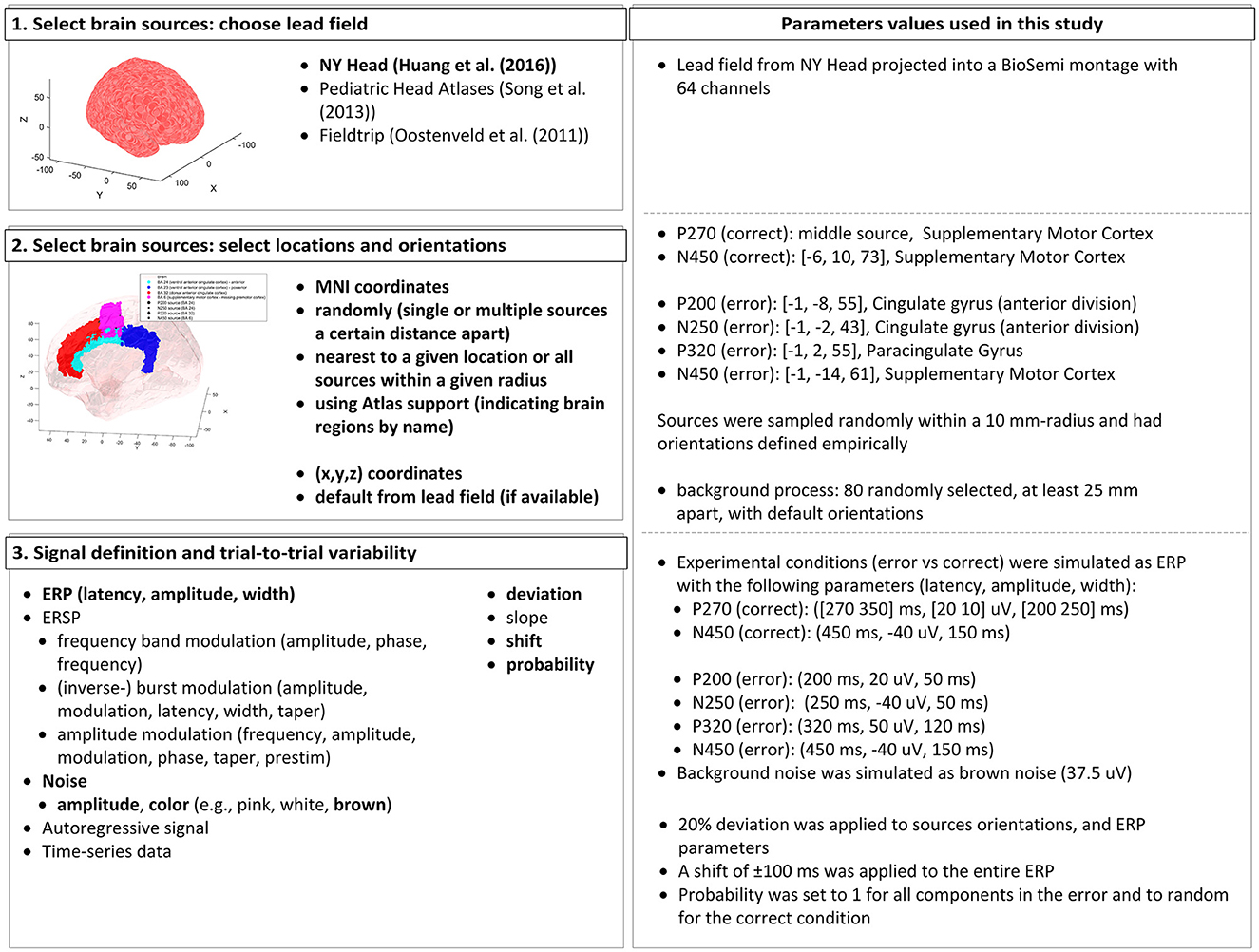
Aline Xavier Fidêncio; Christian Klaes; Ioannis Iossifidis
A Generic Error-Related Potential Classifier Based on Simulated Subjects Journal Article
In: Frontiers in Human Neuroscience, vol. 18, pp. 1390714, 2024, ISSN: 1662-5161.
Abstract | Links | BibTeX | Tags: adaptive brain-machine (computer) interface, BCI, EEG, Error-related potential (ErrP), ErrP classifier, Generic decoder, Machine Learning, SEREEGA, Simulation
@article{xavierfidencioGenericErrorrelatedPotential2024b,

title = {A Generic Error-Related Potential Classifier Based on Simulated Subjects},

author = {Aline Xavier Fidêncio and Christian Klaes and Ioannis Iossifidis},

editor = {Frontiers Media SA},

url = {https://www.frontiersin.org/journals/human-neuroscience/articles/10.3389/fnhum.2024.1390714/full},

doi = {10.3389/fnhum.2024.1390714},

issn = {1662-5161},

year  = {2024},

date = {2024-07-19},

urldate = {2024-07-19},

journal = {Frontiers in Human Neuroscience},

volume = {18},

pages = {1390714},

publisher = {Frontiers},

abstract = {$<$p$>$Error-related potentials (ErrPs) are brain signals known to be generated as a reaction to erroneous events. Several works have shown that not only self-made errors but also mistakes generated by external agents can elicit such event-related potentials. The possibility of reliably measuring ErrPs through non-invasive techniques has increased the interest in the brain-computer interface (BCI) community in using such signals to improve performance, for example, by performing error correction. Extensive calibration sessions are typically necessary to gather sufficient trials for training subject-specific ErrP classifiers. This procedure is not only time-consuming but also boresome for participants. In this paper, we explore the effectiveness of ErrPs in closed-loop systems, emphasizing their dependency on precise single-trial classification. To guarantee the presence of an ErrPs signal in the data we employ and to ensure that the parameters defining ErrPs are systematically varied, we utilize the open-source toolbox SEREEGA for data simulation. We generated training instances and evaluated the performance of the generic classifier on both simulated and real-world datasets, proposing a promising alternative to conventional calibration techniques. Results show that a generic support vector machine classifier reaches balanced accuracies of 72.9%, 62.7%, 71.0%, and 70.8% on each validation dataset. While performing similarly to a leave-one-subject-out approach for error class detection, the proposed classifier shows promising generalization across different datasets and subjects without further adaptation. Moreover, by utilizing SEREEGA, we can systematically adjust parameters to accommodate the variability in the ErrP, facilitating the systematic validation of closed-loop setups. Furthermore, our objective is to develop a universal ErrP classifier that captures the signal's variability, enabling it to determine the presence or absence of an ErrP in real EEG data.$<$/p$>$},

keywords = {adaptive brain-machine (computer) interface, BCI, EEG, Error-related potential (ErrP), ErrP classifier, Generic decoder, Machine Learning, SEREEGA, Simulation},

pubstate = {published},

tppubtype = {article}

}
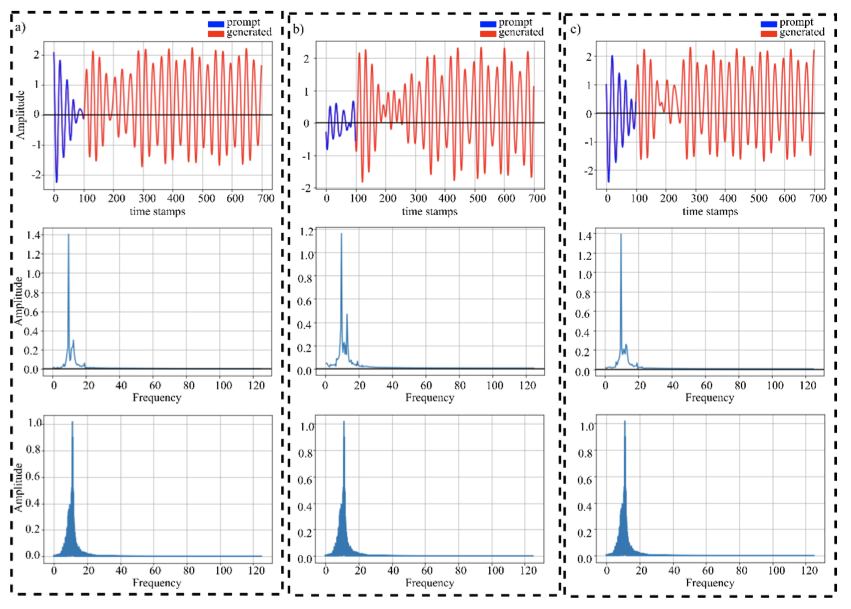
Omair Ali; Muhammad Saif-ur-Rehman; Marita Metzler; Tobias Glasmachers; Ioannis Iossifidis; Christian Klaes
GET: A Generative EEG Transformer for Continuous Context-Based Neural Signals Journal Article
In: arXiv:2406.03115 [q-bio], 2024.
Abstract | Links | BibTeX | Tags: BCI, EEG, Machine Learning, Quantitative Biology - Neurons and Cognition
@article{aliGETGenerativeEEG2024,

title = {GET: A Generative EEG Transformer for Continuous Context-Based Neural Signals},

author = {Omair Ali and Muhammad Saif-ur-Rehman and Marita Metzler and Tobias Glasmachers and Ioannis Iossifidis and Christian Klaes},

url = {http://arxiv.org/abs/2406.03115},

doi = {10.48550/arXiv.2406.03115},

year  = {2024},

date = {2024-06-09},

urldate = {2024-06-09},

journal = {arXiv:2406.03115 [q-bio]},

abstract = {Generating continuous electroencephalography (EEG) signals through advanced artificial neural networks presents a novel opportunity to enhance brain-computer interface (BCI) technology. This capability has the potential to significantly enhance applications ranging from simulating dynamic brain activity and data augmentation to improving real-time epilepsy detection and BCI inference. By harnessing generative transformer neural networks, specifically designed for EEG signal generation, we can revolutionize the interpretation and interaction with neural data. Generative AI has demonstrated significant success across various domains, from natural language processing (NLP) and computer vision to content creation in visual arts and music. It distinguishes itself by using large-scale datasets to construct context windows during pre-training, a technique that has proven particularly effective in NLP, where models are fine-tuned for specific downstream tasks after extensive foundational training. However, the application of generative AI in the field of BCIs, particularly through the development of continuous, context-rich neural signal generators, has been limited. To address this, we introduce the Generative EEG Transformer (GET), a model leveraging transformer architecture tailored for EEG data. The GET model is pre-trained on diverse EEG datasets, including motor imagery and alpha wave datasets, enabling it to produce high-fidelity neural signals that maintain contextual integrity. Our empirical findings indicate that GET not only faithfully reproduces the frequency spectrum of the training data and input prompts but also robustly generates continuous neural signals. By adopting the successful training strategies of the NLP domain for BCIs, the GET sets a new standard for the development and application of neural signal generation technologies.},

keywords = {BCI, EEG, Machine Learning, Quantitative Biology - Neurons and Cognition},

pubstate = {published},

tppubtype = {article}

}
2023
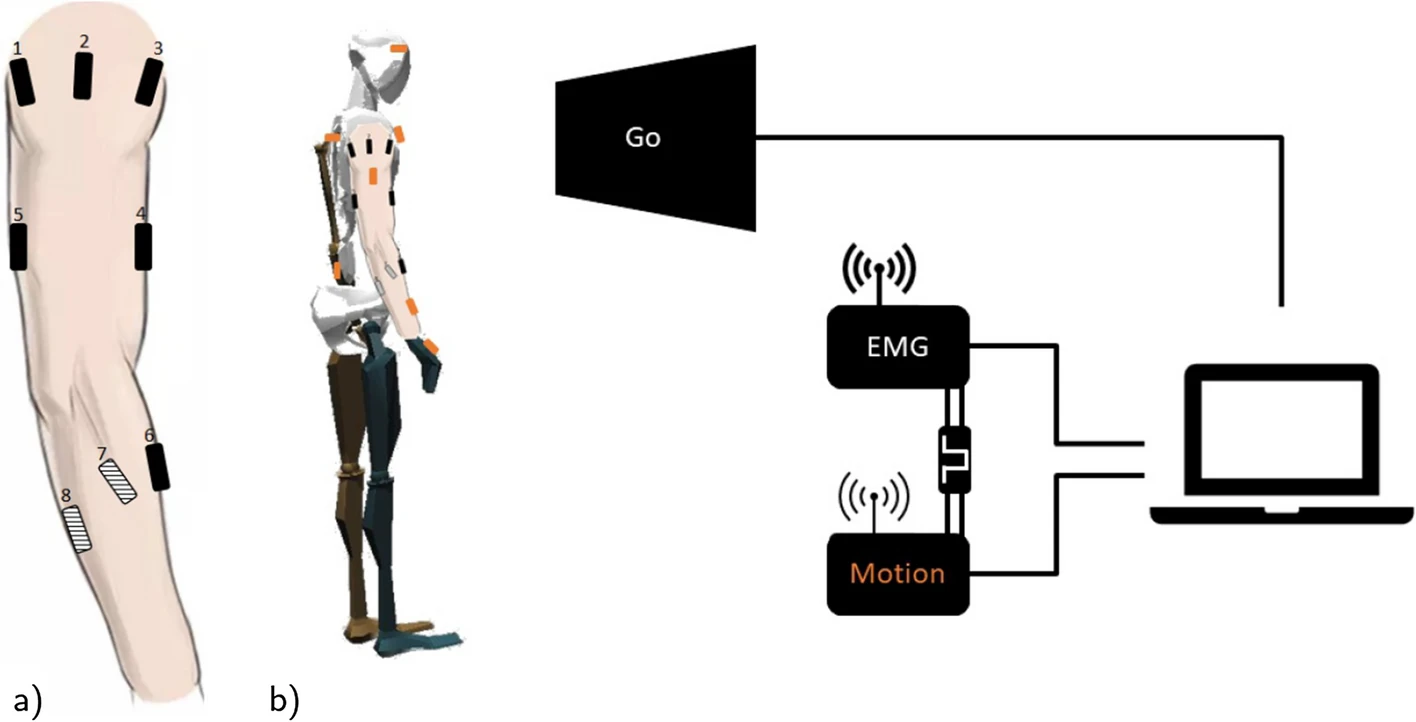
Marie D. Schmidt; Tobias Glasmachers; Ioannis Iossifidis
The Concepts of Muscle Activity Generation Driven by Upper Limb Kinematics Journal Article
In: BioMedical Engineering OnLine, vol. 22, no. 1, pp. 63, 2023, ISSN: 1475-925X.
Abstract | Links | BibTeX | Tags: Artificial generated signal, BCI, Electromyography (EMG), Generative model, Inertial measurement unit (IMU), Machine Learning, Motion parameters, Muscle activity, Neural networks, transfer learning, Voluntary movement
@article{schmidtConceptsMuscleActivity2023,

title = {The Concepts of Muscle Activity Generation Driven by Upper Limb Kinematics},

author = {Marie D. Schmidt and Tobias Glasmachers and Ioannis Iossifidis},

url = {https://doi.org/10.1186/s12938-023-01116-9},

doi = {10.1186/s12938-023-01116-9},

issn = {1475-925X},

year  = {2023},

date = {2023-06-24},

urldate = {2023-06-24},

journal = {BioMedical Engineering OnLine},

volume = {22},

number = {1},

pages = {63},

abstract = {The underlying motivation of this work is to demonstrate that artificial muscle activity of known and unknown motion can be generated based on motion parameters, such as angular position, acceleration, and velocity of each joint (or the end-effector instead), which are similarly represented in our brains. This model is motivated by the known motion planning process in the central nervous system. That process incorporates the current body state from sensory systems and previous experiences, which might be represented as pre-learned inverse dynamics that generate associated muscle activity.},

keywords = {Artificial generated signal, BCI, Electromyography (EMG), Generative model, Inertial measurement unit (IMU), Machine Learning, Motion parameters, Muscle activity, Neural networks, transfer learning, Voluntary movement},

pubstate = {published},

tppubtype = {article}

}
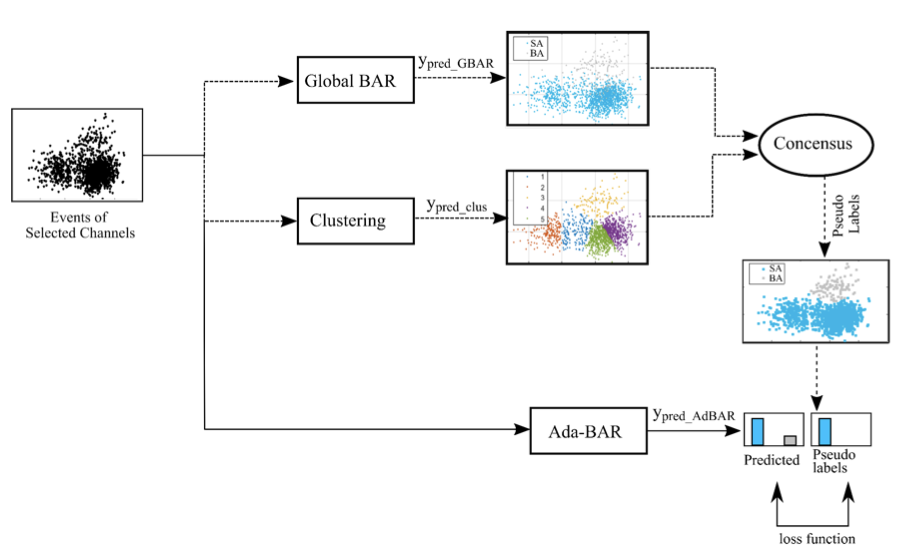
Muhammad Saif-ur-Rehman; Omair Ali; Christian Klaes; Ioannis Iossifidis
Adaptive SpikeDeep-Classifier: Self-organizing and self-supervised machine learning algorithm for online spike sorting Journal Article
In: arXiv:2304.01355 [cs, math, q-bio], 2023.
Links | BibTeX | Tags: BCI, Machine Learning, Spike Sorting
@article{saifurrehman2023adaptive,

title = {Adaptive SpikeDeep-Classifier: Self-organizing and self-supervised machine learning algorithm for online spike sorting},

author = {Muhammad Saif-ur-Rehman and Omair Ali and Christian Klaes and Ioannis Iossifidis},

doi = {10.48550/arXiv.2304.01355},

year  = {2023},

date = {2023-05-02},

urldate = {2023-05-02},

journal = {arXiv:2304.01355 [cs, math, q-bio]},

keywords = {BCI, Machine Learning, Spike Sorting},

pubstate = {published},

tppubtype = {article}

}
2022
Stephan Johann Lehmler; Muhammad Saif-ur-Rehman; Tobias Glasmachers; Ioannis Iossifidis
Deep transfer learning compared to subject-specific models for sEMG decoders Journal Article
In: Journal of Neural Engineering, 2022.
Links | BibTeX | Tags: BCI, Computational Complexity, Deep Transfer-Learning, Machine Learning, transfer learning
@article{lehmlerTransferLearningPatientSpecific2021bb,

title = {Deep transfer learning compared to subject-specific models for sEMG decoders},

author = {Stephan Johann Lehmler and Muhammad Saif-ur-Rehman and Tobias Glasmachers and Ioannis Iossifidis},

url = {http://iopscience.iop.org/article/10.1088/1741-2552/ac9860},

doi = {10.1088/1741-2552/ac9860},

year  = {2022},

date = {2022-10-28},

urldate = {2022-10-28},

journal = {Journal of Neural Engineering},

keywords = {BCI, Computational Complexity, Deep Transfer-Learning, Machine Learning, transfer learning},

pubstate = {published},

tppubtype = {article}

}
Tim Sziburis; Susanne Blex; Ioannis Iossifidis
A Dataset of 3D Hand Transport Trajectories Determined by Inertial Measurements from a Single Sensor Inproceedings
In: BC22 : Computational Neuroscience & Neurotechnology Bernstein Conference 2022, BCCN Bernstein Network Computational Network, 2022.
Links | BibTeX | Tags: BCI, Machine Learning
@inproceedings{sziburisDataset3DHand2022,

title = {A Dataset of 3D Hand Transport Trajectories Determined by Inertial Measurements from a Single Sensor},

author = {Tim Sziburis and Susanne Blex and Ioannis Iossifidis},

doi = {10.12751/nncn.bc2022.186},

year  = {2022},

date = {2022-09-15},

urldate = {2022-09-15},

booktitle = {BC22 : Computational Neuroscience & Neurotechnology Bernstein Conference 2022},

publisher = {BCCN Bernstein Network Computational Network},

keywords = {BCI, Machine Learning},

pubstate = {published},

tppubtype = {inproceedings}

}
Aline Xavier Fidencio; Christian Klaes; Ioannis Iossifidis
Closed-Loop Adaptation of Brain-Machine Interfaces Using Error-Related Potentials and Reinforcement Learning Inproceedings
In: BC22 : Computational Neuroscience & Neurotechnology Bernstein Conference 2022, BCCN Bernstein Network Computational Network, 2022.
Links | BibTeX | Tags: BCI, Machine Learning
@inproceedings{xavierfidencioClosedloopAdaptationBrainmachine2022,

title = {Closed-Loop Adaptation of Brain-Machine Interfaces Using Error-Related Potentials and Reinforcement Learning},

author = {Aline Xavier Fidencio and Christian Klaes and Ioannis Iossifidis},

doi = {10.12751/nncn.bc2022.136},

year  = {2022},

date = {2022-09-15},

urldate = {2022-09-15},

booktitle = {BC22 : Computational Neuroscience & Neurotechnology Bernstein Conference 2022},

publisher = {BCCN Bernstein Network Computational Network},

keywords = {BCI, Machine Learning},

pubstate = {published},

tppubtype = {inproceedings}

}
Marie Dominique Schmidt; Ioannis Iossifidis
Linking Muscle Activity and Motion Trajectory Inproceedings
In: BC22 : Computational Neuroscience & Neurotechnology Bernstein Conference 2022, BCCN Bernstein Network Computational Network, 2022.
Links | BibTeX | Tags: BCI, Machine Learning
@inproceedings{schmidtLinkingMuscleActivity2022,

title = {Linking Muscle Activity and Motion Trajectory},

author = {Marie Dominique Schmidt and Ioannis Iossifidis},

doi = {10.12751/nncn.bc2022.191},

year  = {2022},

date = {2022-09-15},

urldate = {2022-09-15},

booktitle = {BC22 : Computational Neuroscience & Neurotechnology Bernstein Conference 2022},

publisher = {BCCN Bernstein Network Computational Network},

keywords = {BCI, Machine Learning},

pubstate = {published},

tppubtype = {inproceedings}

}
Stephan Johann Lehmler; Muhammad Saif-ur-Rehman; Ioannis Iossifidis
Modeling Subject Specfic Surface EMG Features by Means of Deep Learning Inproceedings
In: BC22 : Computational Neuroscience & Neurotechnology Bernstein Conference 2022, BCCN Bernstein Network Computational Network, 2022.
Links | BibTeX | Tags: BCI, Machine Learning
@inproceedings{lehmlerModelingSubjectSpecfic2022,

title = {Modeling Subject Specfic Surface EMG Features by Means of Deep Learning},

author = {Stephan Johann Lehmler and Muhammad Saif-ur-Rehman and Ioannis Iossifidis},

doi = {10.12751/nncn.bc2022.309},

year  = {2022},

date = {2022-09-15},

urldate = {2022-09-15},

booktitle = {BC22 : Computational Neuroscience & Neurotechnology Bernstein Conference 2022},

publisher = {BCCN Bernstein Network Computational Network},

keywords = {BCI, Machine Learning},

pubstate = {published},

tppubtype = {inproceedings}

}
Aline Xavier Fidencio; Christian Klaes; Ioannis Iossifidis
Error-Related Potentials in Reinforcement Learning-Based Brain-Machine Interfaces Journal Article
In: Frontiers in Human Neuroscience, vol. 16, 2022.
Abstract | Links | BibTeX | Tags: BCI, EEG, error-related potentials, Machine Learning, Reinforcement learning
@article{xavierfidencioErrorrelated,

title = {Error-Related Potentials in Reinforcement Learning-Based Brain-Machine Interfaces},

author = {Aline Xavier Fidencio and Christian Klaes and Ioannis Iossifidis},

url = {https://www.frontiersin.org/article/10.3389/fnhum.2022.806517},

doi = {https://doi.org/10.3389/fnhum.2022.806517},

year  = {2022},

date = {2022-06-24},

urldate = {2022-06-24},

journal = {Frontiers in Human Neuroscience},

volume = {16},

abstract = {The human brain has been an object of extensive investigation in different fields. While several studies have focused on understanding the neural correlates of error processing, advances in brain-machine interface systems using non-invasive techniques further enabled the use of the measured signals in different applications. The possibility of detecting these error-related potentials (ErrPs) under different experimental setups on a single-trial basis has further increased interest in their integration in closed-loop settings to improve system performance, for example, by performing error correction. Fewer works have, however, aimed at reducing future mistakes or learning. We present a review focused on the current literature using non-invasive systems that have combined the ErrPs information specifically in a reinforcement learning framework to go beyond error correction and have used these signals for learning.},

keywords = {BCI, EEG, error-related potentials, Machine Learning, Reinforcement learning},

pubstate = {published},

tppubtype = {article}

}
Omair Ali; Muhammad Saif-ur-Rehman; Tobias Glasmachers; Ioannis Iossifidis; Christian Klaes
ConTraNet: A Single End-to-End Hybrid Network for EEG-based and EMG-based Human Machine Interfaces Journal Article
In: arXiv:2206.10677 [q-bio.NC], 2022.
Abstract | Links | BibTeX | Tags: BCI, Machine Learning, neural processing, signal processing
@article{aliConTraNetSingleEndtoend2022,

title = {ConTraNet: A Single End-to-End Hybrid Network for EEG-based and EMG-based Human Machine Interfaces},

author = {Omair Ali and Muhammad Saif-ur-Rehman and Tobias Glasmachers and Ioannis Iossifidis and Christian Klaes},

url = {http://arxiv.org/abs/2206.10677},

doi = {10.48550/arXiv.2206.10677},

year  = {2022},

date = {2022-06-21},

urldate = {2022-06-21},

journal = {arXiv:2206.10677 [q-bio.NC]},

abstract = {Objective: Electroencephalography (EEG) and electromyography (EMG) are two non-invasive bio-signals, which are widely used in human machine interface (HMI) technologies (EEG-HMI and EMG-HMI paradigm) for the rehabilitation of physically disabled people. Successful decoding of EEG and EMG signals into respective control command is a pivotal step in the rehabilitation process. Recently, several Convolutional neural networks (CNNs) based architectures are proposed that directly map the raw time-series signal into decision space and the process of meaningful features extraction and classification are performed simultaneously. However, these networks are tailored to the learn the expected characteristics of the given bio-signal and are limited to single paradigm. In this work, we addressed the question that can we build a single architecture which is able to learn distinct features from different HMI paradigms and still successfully classify them. Approach: In this work, we introduce a single hybrid model called ConTraNet, which is based on CNN and Transformer architectures that is equally useful for EEG-HMI and EMG-HMI paradigms. ConTraNet uses CNN block to introduce inductive bias in the model and learn local dependencies, whereas the Transformer block uses the self-attention mechanism to learn the long-range dependencies in the signal, which are crucial for the classification of EEG and EMG signals. Main results: We evaluated and compared the ConTraNet with state-of-the-art methods on three publicly available datasets which belong to EEG-HMI and EMG-HMI paradigms. ConTraNet outperformed its counterparts in all the different category tasks (2-class, 3-class, 4-class, and 10-class decoding tasks). Significance: The results suggest that ConTraNet is robust to learn distinct features from different HMI paradigms and generalizes well as compared to the current state of the art algorithms.},

keywords = {BCI, Machine Learning, neural processing, signal processing},

pubstate = {published},

tppubtype = {article}

}
Omair Ali; Muhammad Saif-ur-Rehman; Tobias Glasmachers; Ioannis Iossifidis; Christian Klaes
ConTraNet: A Single End-to-End Hybrid Network for EEG-based and EMG-based Human Machine Interfaces Journal Article
In: 2022.
Abstract | Links | BibTeX | Tags: BCI, Machine Learning, neural processing, signal processing
@article{aliConTraNetSingleEndtoend2022b,

title = {ConTraNet: A Single End-to-End Hybrid Network for EEG-based and EMG-based Human Machine Interfaces},

author = {Omair Ali and Muhammad Saif-ur-Rehman and Tobias Glasmachers and Ioannis Iossifidis and Christian Klaes},

url = {http://arxiv.org/abs/2206.10677},

doi = {10.48550/arXiv.2206.10677},

year  = {2022},

date = {2022-06-21},

urldate = {2022-06-21},

abstract = {Objective: Electroencephalography (EEG) and electromyography (EMG) are two non-invasive bio-signals, which are widely used in human machine interface (HMI) technologies (EEG-HMI and EMG-HMI paradigm) for the rehabilitation of physically disabled people. Successful decoding of EEG and EMG signals into respective control command is a pivotal step in the rehabilitation process. Recently, several Convolutional neural networks (CNNs) based architectures are proposed that directly map the raw time-series signal into decision space and the process of meaningful features extraction and classification are performed simultaneously. However, these networks are tailored to the learn the expected characteristics of the given bio-signal and are limited to single paradigm. In this work, we addressed the question that can we build a single architecture which is able to learn distinct features from different HMI paradigms and still successfully classify them. Approach: In this work, we introduce a single hybrid model called ConTraNet, which is based on CNN and Transformer architectures that is equally useful for EEG-HMI and EMG-HMI paradigms. ConTraNet uses CNN block to introduce inductive bias in the model and learn local dependencies, whereas the Transformer block uses the self-attention mechanism to learn the long-range dependencies in the signal, which are crucial for the classification of EEG and EMG signals. Main results: We evaluated and compared the ConTraNet with state-of-the-art methods on three publicly available datasets which belong to EEG-HMI and EMG-HMI paradigms. ConTraNet outperformed its counterparts in all the different category tasks (2-class, 3-class, 4-class, and 10-class decoding tasks). Significance: The results suggest that ConTraNet is robust to learn distinct features from different HMI paradigms and generalizes well as compared to the current state of the art algorithms.},

keywords = {BCI, Machine Learning, neural processing, signal processing},

pubstate = {published},

tppubtype = {article}

}
Sebastian Doliwa; Andreas Erbeslöh; Karsten Seidl; Ioannis Iossifidis
Development of a Scalable Analog Front-End for Brain-Computer Interfaces Inproceedings
In: 17th International Conference on PhD Research in Microelectronics and Electronics, IEEE Prime 2022, Sardinia, Italy, 2022.
Links | BibTeX | Tags: BCI, Implantable BCI
@inproceedings{doliwaDevelopmentScalableAnalogaccepted,

title = {Development of a Scalable Analog Front-End for Brain-Computer Interfaces},

author = {Sebastian Doliwa and Andreas Erbeslöh and Karsten Seidl and Ioannis Iossifidis},

doi = {10.1109/PRIME55000.2022.9816757},

year  = {2022},

date = {2022-06-15},

urldate = {2022-06-15},

booktitle = {17th International Conference on PhD Research in Microelectronics and Electronics},

publisher = {IEEE Prime 2022},

address = {Sardinia, Italy},

keywords = {BCI, Implantable BCI},

pubstate = {published},

tppubtype = {inproceedings}

}
Sebastian Doliwa; Andreas Erbeslöh; Karsten Seidl; Ioannis Iossifidis
Development of a Scalable Analog Front-End for Brain-Computer Interfaces Inproceedings
In: 17th International Conference on PhD Research in Microelectronics and Electronics, IEEE Prime 2022, Sardinia, Italy, 2022.
BibTeX | Tags: BCI, Implantable BCI
@inproceedings{doliwaDevelopmentScalableAnalogacceptedb,

title = {Development of a Scalable Analog Front-End for Brain-Computer Interfaces},

author = {Sebastian Doliwa and Andreas Erbeslöh and Karsten Seidl and Ioannis Iossifidis},

year  = {2022},

date = {2022-06-15},

urldate = {2022-06-15},

booktitle = {17th International Conference on PhD Research in Microelectronics and Electronics},

publisher = {IEEE Prime 2022},

address = {Sardinia, Italy},

keywords = {BCI, Implantable BCI},

pubstate = {published},

tppubtype = {inproceedings}

}
Omair Ali; Muhammad Saif-ur-Rehman; Susanne Dyck; Tobias Glasmachers; Ioannis Iossifidis; Christian Klaes
Enhancing the decoding accuracy of EEG signals by the introduction of anchored-STFT and adversarial data augmentation method Journal Article
In: Nature Scientific Reports, vol. 12, iss. 1, pp. 4245, 2022, ISSN: 2045-2322.
Abstract | Links | BibTeX | Tags: Adversarial NN, BCI, computer science, EEG, Machine Learning, Quantitative Biology, Quantitative Methods
@article{aliAnchoredSTFTGNAAExtension2021a,

title = {Enhancing the decoding accuracy of EEG signals by the introduction of anchored-STFT and adversarial data augmentation method},

author = {Omair Ali and Muhammad Saif-ur-Rehman and Susanne Dyck and Tobias Glasmachers and Ioannis Iossifidis and Christian Klaes},

url = {https://www.nature.com/articles/s41598-022-07992-w},

doi = {https://doi.org/10.1038/s41598-022-07992-w},

issn = {2045-2322},

year  = {2022},

date = {2022-03-10},

urldate = {2022-03-10},

journal = {Nature Scientific Reports},

volume = {12},

issue = {1},

pages = {4245},

abstract = {Brain-computer interfaces (BCIs) enable communication between humans and machines by translating brain activity into control commands. Electroencephalography (EEG) signals are one of the most used brain signals in non-invasive BCI applications but are often contaminated with noise. Therefore, it is possible that meaningful patterns for classifying EEG signals are deeply hidden. State-of-the-art deep-learning algorithms are successful in learning hidden, meaningful patterns. However, the quality and the quantity of the presented inputs is pivotal. Here, we propose a novel feature extraction method called anchored Short Time Fourier Transform (anchored-STFT), which is an advanced version of STFT, as it minimizes the trade-off between temporal and spectral resolution presented by STFT. In addition, we propose a novel augmentation method, called gradient norm adversarial augmentation (GNAA). GNAA is not only an augmentation method but is also used to harness adversarial inputs in EEG data, which not only improves the classification accuracy but also enhances the robustness of the classifier. In addition, we also propose a new CNN architecture, namely Skip-Net, for the classification of EEG signals. The proposed pipeline outperforms all state-of-the-art methods and yields an average classification accuracy of 90.7 % and 89.54 % on BCI competition II dataset III and BCI competition IV dataset 2b, respectively.},

keywords = {Adversarial NN, BCI, computer science, EEG, Machine Learning, Quantitative Biology, Quantitative Methods},

pubstate = {published},

tppubtype = {article}

}
Omair Ali; Muhammad Saif-ur-Rehman; Susanne Dyck; Tobias Glasmachers; Ioannis Iossifidis; Christian Klaes
Enhancing the decoding accuracy of EEG signals by the introduction of anchored-STFT and adversarial data augmentation method Journal Article
In: Nature Scientific Reports, vol. 12, iss. 1, pp. 4245, 2022, ISSN: 2045-2322.
Abstract | Links | BibTeX | Tags: Adversarial NN, BCI, computer science, EEG, Machine Learning, Quantitative Biology, Quantitative Methods
@article{aliAnchoredSTFTGNAAExtension2021ab,

title = {Enhancing the decoding accuracy of EEG signals by the introduction of anchored-STFT and adversarial data augmentation method},

author = {Omair Ali and Muhammad Saif-ur-Rehman and Susanne Dyck and Tobias Glasmachers and Ioannis Iossifidis and Christian Klaes},

url = {https://www.nature.com/articles/s41598-022-07992-w},

doi = {https://doi.org/10.1038/s41598-022-07992-w},

issn = {2045-2322},

year  = {2022},

date = {2022-03-10},

urldate = {2022-03-10},

journal = {Nature Scientific Reports},

volume = {12},

issue = {1},

pages = {4245},

abstract = {Brain-computer interfaces (BCIs) enable communication between humans and machines by translating brain activity into control commands. Electroencephalography (EEG) signals are one of the most used brain signals in non-invasive BCI applications but are often contaminated with noise. Therefore, it is possible that meaningful patterns for classifying EEG signals are deeply hidden. State-of-the-art deep-learning algorithms are successful in learning hidden, meaningful patterns. However, the quality and the quantity of the presented inputs is pivotal. Here, we propose a novel feature extraction method called anchored Short Time Fourier Transform (anchored-STFT), which is an advanced version of STFT, as it minimizes the trade-off between temporal and spectral resolution presented by STFT. In addition, we propose a novel augmentation method, called gradient norm adversarial augmentation (GNAA). GNAA is not only an augmentation method but is also used to harness adversarial inputs in EEG data, which not only improves the classification accuracy but also enhances the robustness of the classifier. In addition, we also propose a new CNN architecture, namely Skip-Net, for the classification of EEG signals. The proposed pipeline outperforms all state-of-the-art methods and yields an average classification accuracy of 90.7 % and 89.54 % on BCI competition II dataset III and BCI competition IV dataset 2b, respectively.},

keywords = {Adversarial NN, BCI, computer science, EEG, Machine Learning, Quantitative Biology, Quantitative Methods},

pubstate = {published},

tppubtype = {article}

}
Marie Dominique Schmidt; Tobias Glasmachers; Ioannis Iossifidis
From Motion to Muscle Journal Article
In: arXiv: 2201.11501 [cs.LG], 2022.
Links | BibTeX | Tags: BCI, Machine Learning, movement model, muscle signal generator, recurrent neural network
@article{schmidt2022motion,

title = {From Motion to Muscle},

author = {Marie Dominique Schmidt and Tobias Glasmachers and Ioannis Iossifidis},

doi = {https://doi.org/10.48550/arXiv.2201.11501},

year  = {2022},

date = {2022-01-01},

urldate = {2022-01-01},

journal = {arXiv: 2201.11501 [cs.LG]},

keywords = {BCI, Machine Learning, movement model, muscle signal generator, recurrent neural network},

pubstate = {published},

tppubtype = {article}

}
Aline Xavier Fidencio; Tobias Glasmachers; Ioannis Iossifidis
Error-Related Potentials Detection with Dry- and Wet-Electrode EEG Inproceedings
In: FENS, Forum 2022, FENS, Federation of European Neuroscience Societies, 2022.
Abstract | BibTeX | Tags: BCI, EEG, error-related potentials, Machine Learning
@inproceedings{fidencioErrorrelatedPotentialsDetection2022,

title = {Error-Related Potentials Detection with Dry- and Wet-Electrode EEG},

author = {Aline Xavier Fidencio and Tobias Glasmachers and Ioannis Iossifidis},

year  = {2022},

date = {2022-01-01},

urldate = {2022-01-01},

booktitle = {FENS, Forum 2022},

publisher = {FENS, Federation of European Neuroscience Societies},

abstract = {Electroencephalography (EEG) is a non-invasive technique for measuring brain electrical activity from electrodes placed on the scalp surface. Improvements in this technology are particularly relevant because they also boost brain-machine interfaces (BMI) development. Commonly, gel-based electrodes are used since they guarantee a high-quality signal. Alternatively, dry electrodes have been introduced, more suitable for daily use. In this work, we compare conventional dry and wet electrode systems specifically for the detection of error-related potentials (ErrPs). ErrPs are elicited as a reaction to both self-made and external errors. There has been increased interest in the integration of these signals into BMIs to improve their performance since they provide a convenient source of feedback to the system with no extra workload for the subject. These signals can be used, e.g., to correct errors or even for system adaptation. ErrP-based BMIs in the literature have consistently used wet electrodes. Therefore, even though both electrodes types have been compared for other event-related potentials (e.g., P300), it is relevant to know whether the signal quality for the detection of ErrPs is comparable among them. In this work, we implement a simple game to elicit ErrPs and compare the quality of the measured signals. We tested the feasibility of the experimental protocol to elicit ErrP and the measured ErrP displayed a similar waveshape in terms of observed peaks. However, differences exist in both latencies as well as in their amplitude. These variations and other relevant characteristics have to be further verified with more subjects},

keywords = {BCI, EEG, error-related potentials, Machine Learning},

pubstate = {published},

tppubtype = {inproceedings}

}
Marie Dominique Schmidt; Tobias Glasmachers; Ioannis Iossifidis
Motion Intention Prediction Inproceedings
In: FENS, Forum 2022, FENS, Federation of European Neuroscience Societies, 2022.
Abstract | BibTeX | Tags: BCI, Machine Learning, movement model, muscle signal generator, recurrent neural network
@inproceedings{schmidtMotionIntentionPrediction2022a,

title = {Motion Intention Prediction},

author = {Marie Dominique Schmidt and Tobias Glasmachers and Ioannis Iossifidis},

year  = {2022},

date = {2022-01-01},

urldate = {2022-01-01},

booktitle = {FENS, Forum 2022},

publisher = {FENS, Federation of European Neuroscience Societies},

abstract = {Motion intention prediction is the key to robot-assisted rehabilitation systems. These can rely on various biological signals. One commonly used signal is the muscle activity measured by an electromyogram that occurs between 50-100 milliseconds before the actual movement, allowing a real-world application to assist in time. We show that upper limb motion can be estimated from the corresponding muscle activity. To this end, eight-arm muscles are mapped to the joint angle, velocity, and acceleration of the shoulder, elbow, and wrist. For this purpose, we specifically develop an artificial neural network that estimates complex motions involving multiple upper limb joints. The network model is evaluated concerning its ability to generalize across subjects as well as for new motions. This is achieved through training on multiple subjects and additional transfer learning methods so that the prediction for new subjects is significantly improved. In particular, this is beneficial for a robust real-world application. Furthermore, we investigate the importance of the different parameters such as angle, velocity, and acceleration for simple and complex motions. Predictions for simple motions along with the main components of complex motions achieve excellent accuracy while joints that do not play a dominant role during the motion have comparatively lower accuracy.},

keywords = {BCI, Machine Learning, movement model, muscle signal generator, recurrent neural network},

pubstate = {published},

tppubtype = {inproceedings}

}
Marie Dominique Schmidt; Tobias Glasmachers; Ioannis Iossifidis
From Motion to Muscle Journal Article
In: arXiv: 2201.11501 [cs.LG], 2022.
Links | BibTeX | Tags: BCI, Machine Learning, movement model, muscle signal generator, recurrent neural network
@article{schmidt2022motionb,

title = {From Motion to Muscle},

author = {Marie Dominique Schmidt and Tobias Glasmachers and Ioannis Iossifidis},

doi = {https://doi.org/10.48550/arXiv.2201.11501},

year  = {2022},

date = {2022-01-01},

urldate = {2022-01-01},

journal = {arXiv: 2201.11501 [cs.LG]},

keywords = {BCI, Machine Learning, movement model, muscle signal generator, recurrent neural network},

pubstate = {published},

tppubtype = {article}

}
Aline Xavier Fidencio; Tobias Glasmachers; Ioannis Iossifidis
Error-Related Potentials Detection with Dry- and Wet-Electrode EEG Inproceedings
In: FENS, Forum 2022, FENS, Federation of European Neuroscience Societies, 2022.
Abstract | BibTeX | Tags: BCI, EEG, error-related potentials, Machine Learning
@inproceedings{fidencioErrorrelatedPotentialsDetection2022b,

title = {Error-Related Potentials Detection with Dry- and Wet-Electrode EEG},

author = {Aline Xavier Fidencio and Tobias Glasmachers and Ioannis Iossifidis},

year  = {2022},

date = {2022-01-01},

urldate = {2022-01-01},

booktitle = {FENS, Forum 2022},

publisher = {FENS, Federation of European Neuroscience Societies},

abstract = {Electroencephalography (EEG) is a non-invasive technique for measuring brain electrical activity from electrodes placed on the scalp surface. Improvements in this technology are particularly relevant because they also boost brain-machine interfaces (BMI) development. Commonly, gel-based electrodes are used since they guarantee a high-quality signal. Alternatively, dry electrodes have been introduced, more suitable for daily use. In this work, we compare conventional dry and wet electrode systems specifically for the detection of error-related potentials (ErrPs). ErrPs are elicited as a reaction to both self-made and external errors. There has been increased interest in the integration of these signals into BMIs to improve their performance since they provide a convenient source of feedback to the system with no extra workload for the subject. These signals can be used, e.g., to correct errors or even for system adaptation. ErrP-based BMIs in the literature have consistently used wet electrodes. Therefore, even though both electrodes types have been compared for other event-related potentials (e.g., P300), it is relevant to know whether the signal quality for the detection of ErrPs is comparable among them. In this work, we implement a simple game to elicit ErrPs and compare the quality of the measured signals. We tested the feasibility of the experimental protocol to elicit ErrP and the measured ErrP displayed a similar waveshape in terms of observed peaks. However, differences exist in both latencies as well as in their amplitude. These variations and other relevant characteristics have to be further verified with more subjects},

keywords = {BCI, EEG, error-related potentials, Machine Learning},

pubstate = {published},

tppubtype = {inproceedings}

}
Marie Dominique Schmidt; Tobias Glasmachers; Ioannis Iossifidis
Motion Intention Prediction Inproceedings
In: FENS, Forum 2022, FENS, Federation of European Neuroscience Societies, 2022.
Abstract | BibTeX | Tags: BCI, Machine Learning, movement model, muscle signal generator, recurrent neural network
@inproceedings{schmidtMotionIntentionPrediction2022ab,

title = {Motion Intention Prediction},

author = {Marie Dominique Schmidt and Tobias Glasmachers and Ioannis Iossifidis},

year  = {2022},

date = {2022-01-01},

urldate = {2022-01-01},

booktitle = {FENS, Forum 2022},

publisher = {FENS, Federation of European Neuroscience Societies},

abstract = {Motion intention prediction is the key to robot-assisted rehabilitation systems. These can rely on various biological signals. One commonly used signal is the muscle activity measured by an electromyogram that occurs between 50-100 milliseconds before the actual movement, allowing a real-world application to assist in time. We show that upper limb motion can be estimated from the corresponding muscle activity. To this end, eight-arm muscles are mapped to the joint angle, velocity, and acceleration of the shoulder, elbow, and wrist. For this purpose, we specifically develop an artificial neural network that estimates complex motions involving multiple upper limb joints. The network model is evaluated concerning its ability to generalize across subjects as well as for new motions. This is achieved through training on multiple subjects and additional transfer learning methods so that the prediction for new subjects is significantly improved. In particular, this is beneficial for a robust real-world application. Furthermore, we investigate the importance of the different parameters such as angle, velocity, and acceleration for simple and complex motions. Predictions for simple motions along with the main components of complex motions achieve excellent accuracy while joints that do not play a dominant role during the motion have comparatively lower accuracy.},

keywords = {BCI, Machine Learning, movement model, muscle signal generator, recurrent neural network},

pubstate = {published},

tppubtype = {inproceedings}

}
2021
Stephan Johann Lehmler; Muhammad Saif-ur-Rehman; Tobias Glasmachers; Ioannis Iossifidis
Transfer-Learning for Patient Specific Model Re-Calibration: Application to sEMG-Classification Inproceedings
In: Bernstein Conferen, 2021.
Links | BibTeX | Tags: BCI, Computational Complexity, Deep Transfer-Learning, Machine Learning, transfer learning
@inproceedings{lehmlerTransferLearningPatientSpecific2021b,

title = {Transfer-Learning for Patient Specific Model Re-Calibration: Application to sEMG-Classification},

author = {Stephan Johann Lehmler and Muhammad Saif-ur-Rehman and Tobias Glasmachers and Ioannis Iossifidis},

doi = {10.12751/nncn.bc2021.p005},

year  = {2021},

date = {2021-10-01},

urldate = {2021-10-01},

publisher = {Bernstein Conferen},

keywords = {BCI, Computational Complexity, Deep Transfer-Learning, Machine Learning, transfer learning},

pubstate = {published},

tppubtype = {inproceedings}

}
Marie Dominique Schmidt; Tobias Glasmachers; Ioannis Iossifidis
Artificially Generated Muscle Signals Inproceedings
In: Bernstein Conference, 2021.
Links | BibTeX | Tags: BCI, Machine Learning, movement model, muscle signal generator, recurrent neural network
@inproceedings{schmidtArtificiallyGeneratedMuscle2021b,

title = {Artificially Generated Muscle Signals},

author = {Marie Dominique Schmidt and Tobias Glasmachers and Ioannis Iossifidis},

doi = {10.12751/nncn.bc2021.p111},

year  = {2021},

date = {2021-10-01},

urldate = {2021-10-01},

publisher = {Bernstein Conference},

keywords = {BCI, Machine Learning, movement model, muscle signal generator, recurrent neural network},

pubstate = {published},

tppubtype = {inproceedings}

}
Aline Xavier Fidencio; Tobias Glasmachers; Christian Klaes; Ioannis Iossifidis
Beyond Error Correction: Integration of Error-Related Potentials into Brain-Computer Interfaces for Improved Performance Inproceedings
In: Bernstein Conference, 2021.
Links | BibTeX | Tags: BCI, error-related potentials, Machine Learning, Reinforcement learning
@inproceedings{xavierfidencioErrorCorrectionIntegration2021b,

title = {Beyond Error Correction: Integration of Error-Related Potentials into Brain-Computer Interfaces for Improved Performance},

author = {Aline Xavier Fidencio and Tobias Glasmachers and Christian Klaes and Ioannis Iossifidis},

doi = {10.12751/nncn.bc2021.p163},

year  = {2021},

date = {2021-10-01},

urldate = {2021-10-01},

publisher = {Bernstein Conference},

keywords = {BCI, error-related potentials, Machine Learning, Reinforcement learning},

pubstate = {published},

tppubtype = {inproceedings}

}
Stephan Johann Lehmler; Muhammad Saif-ur-Rehman; Tobias Glasmachers; Ioannis Iossifidis
Transfer-Learning for Patient Specific Model Re-Calibration: Application to sEMG-Classification Inproceedings
In: Bernstein Conferen, 2021.
Links | BibTeX | Tags: BCI, Computational Complexity, Deep Transfer-Learning, Machine Learning, transfer learning
@inproceedings{lehmlerTransferLearningPatientSpecific2021bc,

title = {Transfer-Learning for Patient Specific Model Re-Calibration: Application to sEMG-Classification},

author = {Stephan Johann Lehmler and Muhammad Saif-ur-Rehman and Tobias Glasmachers and Ioannis Iossifidis},

doi = {10.12751/nncn.bc2021.p005},

year  = {2021},

date = {2021-10-01},

urldate = {2021-10-01},

publisher = {Bernstein Conferen},

keywords = {BCI, Computational Complexity, Deep Transfer-Learning, Machine Learning, transfer learning},

pubstate = {published},

tppubtype = {inproceedings}

}
Marie Dominique Schmidt; Tobias Glasmachers; Ioannis Iossifidis
Artificially Generated Muscle Signals Inproceedings
In: Bernstein Conference, 2021.
Links | BibTeX | Tags: BCI, Machine Learning, movement model, muscle signal generator, recurrent neural network
@inproceedings{schmidtArtificiallyGeneratedMuscle2021bb,

title = {Artificially Generated Muscle Signals},

author = {Marie Dominique Schmidt and Tobias Glasmachers and Ioannis Iossifidis},

doi = {10.12751/nncn.bc2021.p111},

year  = {2021},

date = {2021-10-01},

urldate = {2021-10-01},

publisher = {Bernstein Conference},

keywords = {BCI, Machine Learning, movement model, muscle signal generator, recurrent neural network},

pubstate = {published},

tppubtype = {inproceedings}

}
Aline Xavier Fidencio; Tobias Glasmachers; Christian Klaes; Ioannis Iossifidis
Beyond Error Correction: Integration of Error-Related Potentials into Brain-Computer Interfaces for Improved Performance Inproceedings
In: Bernstein Conference, 2021.
Links | BibTeX | Tags: BCI, error-related potentials, Machine Learning, Reinforcement learning
@inproceedings{xavierfidencioErrorCorrectionIntegration2021bb,

title = {Beyond Error Correction: Integration of Error-Related Potentials into Brain-Computer Interfaces for Improved Performance},

author = {Aline Xavier Fidencio and Tobias Glasmachers and Christian Klaes and Ioannis Iossifidis},

doi = {10.12751/nncn.bc2021.p163},

year  = {2021},

date = {2021-10-01},

urldate = {2021-10-01},

publisher = {Bernstein Conference},

keywords = {BCI, error-related potentials, Machine Learning, Reinforcement learning},

pubstate = {published},

tppubtype = {inproceedings}

}
Marie Dominique Schmidt; Tobias Glasmachers; Ioannis Iossifidis
Artificially Generated Muscle Signals Inproceedings
In: BC21 : Computational Neuroscience & Neurotechnology Bernstein Conference 2021, BCCN Bernstein Network Computational Network, 2021.
Links | BibTeX | Tags: BCI, Machine Learning
@inproceedings{schmidtArtificiallyGeneratedMuscle2021,

title = {Artificially Generated Muscle Signals},

author = {Marie Dominique Schmidt and Tobias Glasmachers and Ioannis Iossifidis},

doi = {10.12751/nncn.bc2021.p111},

year  = {2021},

date = {2021-09-15},

urldate = {2021-09-15},

booktitle = {BC21 : Computational Neuroscience & Neurotechnology Bernstein Conference 2021},

publisher = {BCCN Bernstein Network Computational Network},

keywords = {BCI, Machine Learning},

pubstate = {published},

tppubtype = {inproceedings}

}
Tim Sziburis; Susanne Blex; Tobias Glasmachers; Inaki Rano; Ioannis Iossifidis
Modelling the Generation of Human Upper-Limb Reaching Trajectories: An Extended Behavioural Attractor Dynamics Approach Inproceedings
In: BC21 : Computational Neuroscience & Neurotechnology Bernstein Conference 2021, BCCN Bernstein Network Computational Network, 2021.
Links | BibTeX | Tags: BCI, Machine Learning, movement model
@inproceedings{sziburisModellingGenerationHuman2021,

title = {Modelling the Generation of Human Upper-Limb Reaching Trajectories: An Extended Behavioural Attractor Dynamics Approach},

author = {Tim Sziburis and Susanne Blex and Tobias Glasmachers and Inaki Rano and Ioannis Iossifidis},

doi = {10.12751/nncn.bc2021.p078},

year  = {2021},

date = {2021-09-15},

urldate = {2021-09-15},

booktitle = {BC21 : Computational Neuroscience & Neurotechnology Bernstein Conference 2021},

publisher = {BCCN Bernstein Network Computational Network},

keywords = {BCI, Machine Learning, movement model},

pubstate = {published},

tppubtype = {inproceedings}

}
Stephan Johann Lehmler; Muhammad Saif-ur-Rehman; Tobias Glasmachers; Ioannis Iossifidis
Transfer-Learning for Patient Specific Model Re-Calibration: Application to sEMG-Classification Inproceedings
In: BC21 : Computational Neuroscience & Neurotechnology Bernstein Conference 2021, BCCN Bernstein Network Computational Network, 2021.
Links | BibTeX | Tags: BCI, Machine Learning
@inproceedings{lehmlerTransferLearningPatientSpecific2021,

title = {Transfer-Learning for Patient Specific Model Re-Calibration: Application to sEMG-Classification},

author = {Stephan Johann Lehmler and Muhammad Saif-ur-Rehman and Tobias Glasmachers and Ioannis Iossifidis},

doi = {10.12751/nncn.bc2021.p005},

year  = {2021},

date = {2021-09-15},

urldate = {2021-09-15},

booktitle = {BC21 : Computational Neuroscience & Neurotechnology Bernstein Conference 2021},

publisher = {BCCN Bernstein Network Computational Network},

keywords = {BCI, Machine Learning},

pubstate = {published},

tppubtype = {inproceedings}

}
Aline Xavier Fidencio; Tobias Glasmachers; Christian Klaes; Ioannis Iossifidis
Beyond error correction: Integration of error-related potentials into brain-computer interfaces for improved performance Inproceedings
In: BC21 : Computational Neuroscience & Neurotechnology Bernstein Conference 2021, BCCN Bernstein Network Computational Network, 2021.
Links | BibTeX | Tags: BCI, Machine Learning
@inproceedings{xavierfidencioErrorCorrectionIntegration2021,

title = {Beyond error correction: Integration of error-related potentials into brain-computer interfaces for improved performance},

author = {Aline Xavier Fidencio and Tobias Glasmachers and Christian Klaes and Ioannis Iossifidis},

doi = {10.12751/nncn.bc2021.p163},

year  = {2021},

date = {2021-09-15},

urldate = {2021-09-15},

booktitle = {BC21 : Computational Neuroscience & Neurotechnology Bernstein Conference 2021},

publisher = {BCCN Bernstein Network Computational Network},

keywords = {BCI, Machine Learning},

pubstate = {published},

tppubtype = {inproceedings}

}
Omair Ali; Muhammad Saif-ur-Rehman; Susanne Dyck; Tobias Glasmachers; Ioannis Iossifidis; Christian Klaes
Anchored-STFT and GNAA: An Extension of STFT in Conjunction with an Adversarial Data Augmentation Technique for the Decoding of Neural Signals Journal Article
In: arXiv:2011.14694 [cs, q-bio], 2021.
Abstract | BibTeX | Tags: BCI, Machine Learning, Quantitative Biology, Quantitative Methods
@article{aliAnchoredSTFTGNAAExtension2021,

title = {Anchored-STFT and GNAA: An Extension of STFT in Conjunction with an Adversarial Data Augmentation Technique for the Decoding of Neural Signals},

author = {Omair Ali and Muhammad Saif-ur-Rehman and Susanne Dyck and Tobias Glasmachers and Ioannis Iossifidis and Christian Klaes},

year  = {2021},

date = {2021-08-01},

urldate = {2021-08-01},

journal = {arXiv:2011.14694 [cs, q-bio]},

abstract = {Brain-computer interfaces (BCIs) enable communication between humans and machines by translating brain activity into control commands. Electroencephalography (EEG) signals are one of the most used brain signals in non-invasive BCI applications but are often contaminated with noise. Therefore, it is possible that meaningful patterns for classifying EEG signals are deeply hidden. State-of-the-art deep-learning algorithms are successful in learning hidden, meaningful patterns. However, the quality and the quantity of the presented inputs is pivotal. Here, we propose a novel feature extraction method called anchored Short Time Fourier Transform (anchored-STFT), which is an advanced version of STFT, as it minimizes the trade-off between temporal and spectral resolution presented by STFT. In addition, we propose a novel augmentation method, called gradient norm adversarial augmentation (GNAA). GNAA is not only an augmentation method but is also used to harness adversarial inputs in EEG data, which not only improves the classification accuracy but also enhances the robustness of the classifier. In addition, we also propose a new CNN architecture, namely Skip-Net, for the classification of EEG signals. The proposed pipeline outperforms all state-of-the-art methods and yields an average classification accuracy of 90.7 % and 89.54 % on BCI competition II dataset III and BCI competition IV dataset 2b, respectively.},

keywords = {BCI, Machine Learning, Quantitative Biology, Quantitative Methods},

pubstate = {published},

tppubtype = {article}

}
Omair Ali; Muhammad Saif-ur-Rehman; Susanne Dyck; Tobias Glasmachers; Ioannis Iossifidis; Christian Klaes
Anchored-STFT and GNAA: An Extension of STFT in Conjunction with an Adversarial Data Augmentation Technique for the Decoding of Neural Signals Journal Article
In: arXiv:2011.14694 [cs, q-bio], 2021.
Abstract | BibTeX | Tags: BCI, Machine Learning, Quantitative Biology, Quantitative Methods
@article{aliAnchoredSTFTGNAAExtension2021d,

title = {Anchored-STFT and GNAA: An Extension of STFT in Conjunction with an Adversarial Data Augmentation Technique for the Decoding of Neural Signals},

author = {Omair Ali and Muhammad Saif-ur-Rehman and Susanne Dyck and Tobias Glasmachers and Ioannis Iossifidis and Christian Klaes},

year  = {2021},

date = {2021-08-01},

urldate = {2021-08-01},

journal = {arXiv:2011.14694 [cs, q-bio]},

abstract = {Brain-computer interfaces (BCIs) enable communication between humans and machines by translating brain activity into control commands. Electroencephalography (EEG) signals are one of the most used brain signals in non-invasive BCI applications but are often contaminated with noise. Therefore, it is possible that meaningful patterns for classifying EEG signals are deeply hidden. State-of-the-art deep-learning algorithms are successful in learning hidden, meaningful patterns. However, the quality and the quantity of the presented inputs is pivotal. Here, we propose a novel feature extraction method called anchored Short Time Fourier Transform (anchored-STFT), which is an advanced version of STFT, as it minimizes the trade-off between temporal and spectral resolution presented by STFT. In addition, we propose a novel augmentation method, called gradient norm adversarial augmentation (GNAA). GNAA is not only an augmentation method but is also used to harness adversarial inputs in EEG data, which not only improves the classification accuracy but also enhances the robustness of the classifier. In addition, we also propose a new CNN architecture, namely Skip-Net, for the classification of EEG signals. The proposed pipeline outperforms all state-of-the-art methods and yields an average classification accuracy of 90.7 % and 89.54 % on BCI competition II dataset III and BCI competition IV dataset 2b, respectively.},

keywords = {BCI, Machine Learning, Quantitative Biology, Quantitative Methods},

pubstate = {published},

tppubtype = {article}

}
Stephan Johann Lehmler; Muhammad Saif-ur-Rehman; Tobias Glasmachers; Ioannis Iossifidis
Deep Transfer-Learning for patient specific model re-calibration: Application to sEMG-Classification Journal Article
In: 2021.
Links | BibTeX | Tags: BCI, Computational Complexity, Deep Transfer-Learning, Machine Learning
@article{lehmler2021deep,

title = {Deep Transfer-Learning for patient specific model re-calibration: Application to sEMG-Classification},

author = {Stephan Johann Lehmler and Muhammad Saif-ur-Rehman and Tobias Glasmachers and Ioannis Iossifidis},

url = {https://api.semanticscholar.org/CorpusID:245634948},

year  = {2021},

date = {2021-01-01},

urldate = {2021-01-01},

keywords = {BCI, Computational Complexity, Deep Transfer-Learning, Machine Learning},

pubstate = {published},

tppubtype = {article}

}
Stephan Johann Lehmler; Muhammad Saif-ur-Rehman; Tobias Glasmachers; Ioannis Iossifidis
Deep Transfer-Learning for patient specific model re-calibration: Application to sEMG-Classification Journal Article
In: 2021.
Links | BibTeX | Tags: BCI, Computational Complexity, Deep Transfer-Learning, Machine Learning
@article{lehmler2021deepb,

title = {Deep Transfer-Learning for patient specific model re-calibration: Application to sEMG-Classification},

author = {Stephan Johann Lehmler and Muhammad Saif-ur-Rehman and Tobias Glasmachers and Ioannis Iossifidis},

url = {https://api.semanticscholar.org/CorpusID:245634948},

year  = {2021},

date = {2021-01-01},

urldate = {2021-01-01},

keywords = {BCI, Computational Complexity, Deep Transfer-Learning, Machine Learning},

pubstate = {published},

tppubtype = {article}

}