Skip to content
iLab: From Brain to Machine and Back

iLab: From Brain to Machine and Back

iossifidis Lab

  • Home
  • Research Projects
  • Publications
  • Software
  • Press and Media
  • Student’s Zone — Teaching
    • Thesis topics
    • Student Projects
    • Journal Club & Progress Club
    • Lab Course
    • Lectures – Vorlesungen
  • About us
    • The Team
    • Contact
    • Impressum
  • Home
  • 2020
  • November
  • 2
  • Motor‐parietal cortical neuroprosthesis with somatosensory feedback for restoring hand and arm functions in tetraplegic patients
Motor‐parietal cortical neuroprosthesis with somatosensory feedback for restoring hand and arm functions in tetraplegic patients

Motor‐parietal cortical neuroprosthesis with somatosensory feedback for restoring hand and arm functions in tetraplegic patients

Posted on November 2, 2020April 2, 2022 By jannis No Comments on Motor‐parietal cortical neuroprosthesis with somatosensory feedback for restoring hand and arm functions in tetraplegic patients
press release, research grand

DFG: Emmy-Noether-Grand: Dr. Christian Klaes (PI, Coordinator), Prof. Dr. Kirsten Schmieder (PI), Prof. Dr. Ioannis Iossifidis (PI).
03/2016 — 02/2021

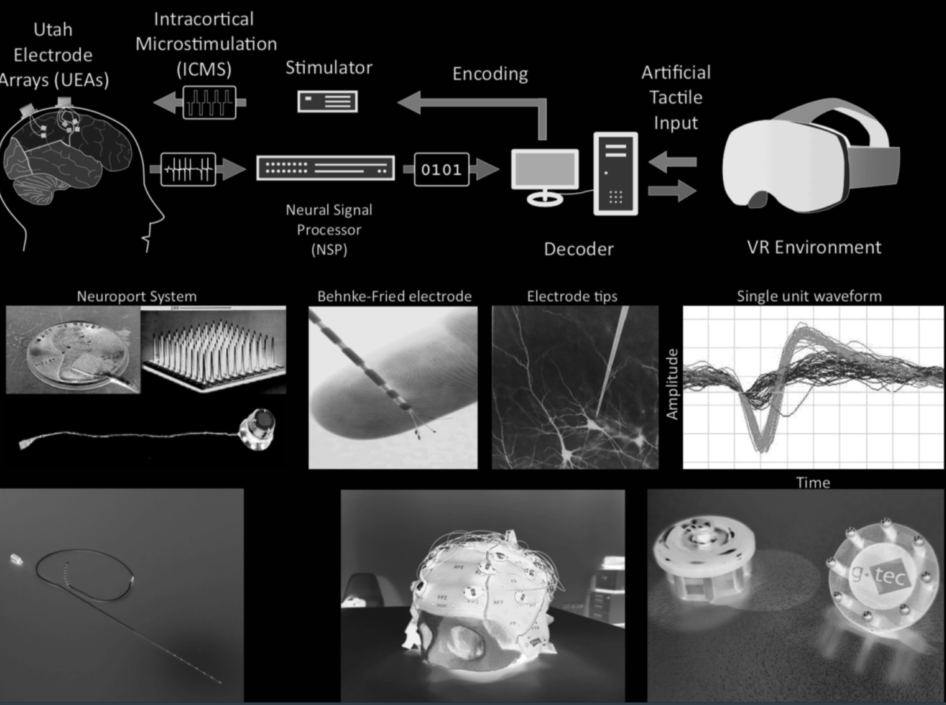
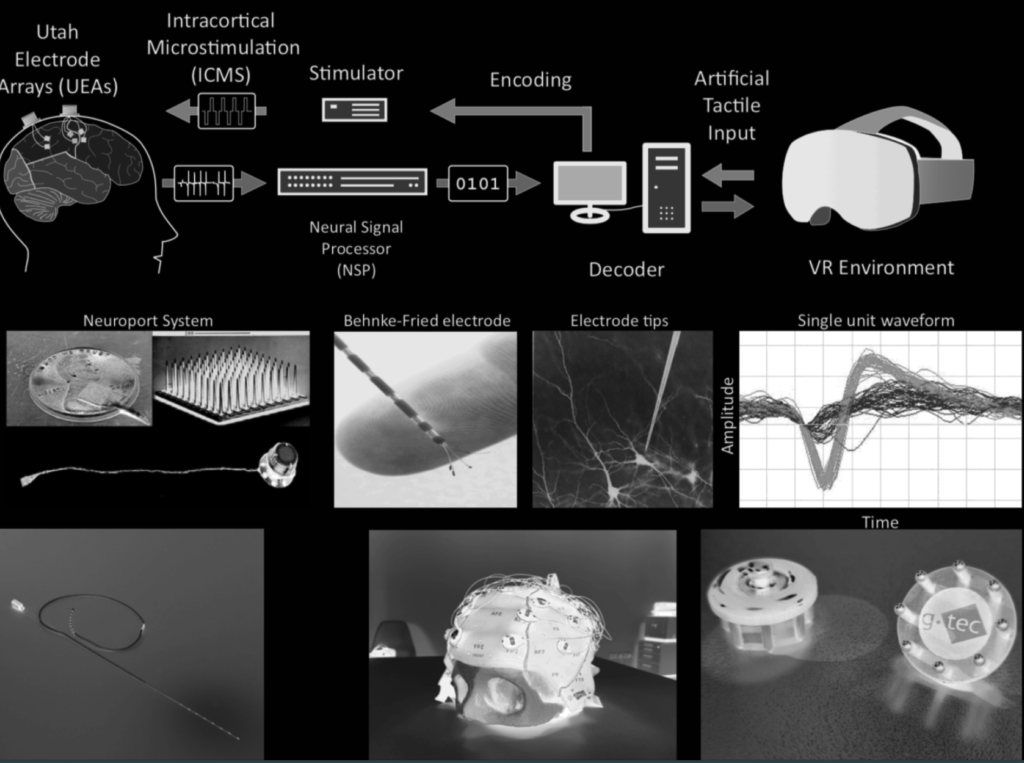
Tetraplegic patients are paralyzed from the neck down. Their severe condition is often the result of car accidents or falls. According to the National Spinal Cord Injury Statistical Center approximately 160.000 persons in the USA are living with complete or partial tetraplegia as of 2014. In Germany about 1200‐ 1500 new cases of paralyzing spinal cord injuries are registered each year. 900 of those are the results of accidents. The average age at time of injury is 40 years and 70% of patients are male. Currently there is no way to cure the condition but constant technological advances have improved the autonomy of patients significantly. Although restricted in various ways a majority of tetraplegics rates the restoration of hand and arm functions as being of highest importance to them (Anderson, 2004). A range of assistive technologies, like motorized wheelchairs and extracorporeal robotic arms, are available to help paralyzed individuals regain control of their environment, but controlling these devices remains a challenge. One intriguing way to intuitively regain control of anthropomorphic robotic limbs is to use a brain‐computer interface (BCI).

This project is intended as a pilot study for human neuroprosthetic research in Germany. The aim is to establish a BCI research lab which will use state of the art technology and innovative concepts to advance the field of neuroprosthetics and neuroscience in general.

The project is split into two phases.

In the first phase we will develop the software infrastructure for BCI control which will be based on software that was used in the Caltech human subject study. The software will include a fully immersive VR environment including functional models of robotic limbs which have been used in several clinical studies. The software will also manage the application of electrical cortical stimulation when parts of the virtual robotic limbs are touched to create a virtual sense of touch. Stimulation artifact removal from the neuronal signal will be included as well to allow decoding of movement intentions while stimulation is applied. 

Furthermore the software will allow for adaptive assistance to integrate high‐level movement intentions (from PPC) and low‐level movement trajectories (from primary motor cortex) with computer intelligence to provide an optimal level of control for the patient. In this first phase we will collect data from consenting epilepsy patients who are implanted with ECoG grids for medical reasons. ECoG grids are implanted in these patients for a short time prior to epilepsy surgery to locate epileptogenic zones. Patients who have grids implanted over areas we are interested in, primary motor cortex, primary somatosensory cortex and PPC, could participate in the first phase. We will use the recorded LFP signals to control virtual robotic limbs and other devices. The patients will learn to control computer cursors on a screen and virtual robotic limbs within the VR environment. Within the VR environment we will optimize control paradigms in a variety of scenarios.

For further information see also

University Hospital Knappschaftskrankenhaus

Tags: research-project

Post navigation

❮ Previous Post: Spike-Deeptector in conjunction with artifact rejector: A deep-learning based feature extractor for online invasive BCI applications (Thesis-Proposal)
Next Post: Smart upper extremity rehabilitation with an intelligent soft exoskeleton (REXO) ❯

Leave a Reply Cancel reply

Your email address will not be published. Required fields are marked *

Recent Posts

  • (no title) June 18, 2026
  • New journal article: Predicting Muscle Activity from Upper Limb Kinematics with LSTM Networks June 7, 2026
  • New preprint: The Spatial and Temporal Resolution of Motor Intention in Multi-Target Prediction June 7, 2026
  • New paper: Performance Boundaries for BCIs Using Error-Related Potentials and Reinforcement Learning June 7, 2026
  • New paper: Distributional Properties of ReLU-Activations in Neural Networks That Learn by Memorization June 7, 2026

Recent Comments

    Archives

    • June 2026
    • May 2026
    • October 2025
    • January 2025
    • October 2024
    • September 2024
    • September 2023
    • June 2023
    • December 2022
    • October 2022
    • September 2022
    • May 2022
    • February 2022
    • January 2022
    • November 2021
    • August 2021
    • June 2021
    • April 2021
    • March 2021
    • February 2021
    • December 2020
    • November 2020
    • October 2020
    • September 2020
    • September 2019
    • October 2018
    • December 2017
    • September 2017
    • July 2016
    • December 2015
    • November 2013
    • October 2013
    • August 2013
    • May 2013
    • July 2012
    • March 2012
    • February 2012
    • January 2012
    • December 2011
    • September 2011
    • March 2011
    • June 2010
    • May 2010
    • April 2010
    • March 2010
    • September 2009
    • July 2009
    • May 2009
    • April 2009
    • March 2009
    • February 2009

    Categories

    • Conference participation
    • Grant
    • invited talk
    • journal club
    • press release
    • progress club
    • publication
    • research grand
    • scientific publication
    • software released
    • teaching
    • workshop

    Meta

    • Log in
    • Entries feed
    • Comments feed
    • WordPress.org

    Copyright © Ioannis Iossifidis 2020 iLab: From Brain to Machine and Back.

    Theme: Oceanly by ScriptsTown

    We use cookies on our website to give you the most relevant experience by remembering your preferences and repeat visits. By clicking “Accept All”, you consent to the use of ALL the cookies. However, you may visit "Cookie Settings" to provide a controlled consent.
    Cookie SettingsAccept All
    Manage consent

    Privacy Overview

    This website uses cookies to improve your experience while you navigate through the website. Out of these, the cookies that are categorized as necessary are stored on your browser as they are essential for the working of basic functionalities of the website. We also use third-party cookies that help us analyze and understand how you use this website. These cookies will be stored in your browser only with your consent. You also have the option to opt-out of these cookies. But opting out of some of these cookies may affect your browsing experience.
    Necessary
    Always Enabled
    Necessary cookies are absolutely essential for the website to function properly. These cookies ensure basic functionalities and security features of the website, anonymously.
    CookieDurationDescription
    cookielawinfo-checkbox-analytics11 monthsThis cookie is set by GDPR Cookie Consent plugin. The cookie is used to store the user consent for the cookies in the category "Analytics".
    cookielawinfo-checkbox-functional11 monthsThe cookie is set by GDPR cookie consent to record the user consent for the cookies in the category "Functional".
    cookielawinfo-checkbox-functional11 monthsThe cookie is set by GDPR cookie consent to record the user consent for the cookies in the category "Functional".
    cookielawinfo-checkbox-necessary11 monthsThis cookie is set by GDPR Cookie Consent plugin. The cookies is used to store the user consent for the cookies in the category "Necessary".
    cookielawinfo-checkbox-necessary11 monthsThis cookie is set by GDPR Cookie Consent plugin. The cookies is used to store the user consent for the cookies in the category "Necessary".
    cookielawinfo-checkbox-others11 monthsThis cookie is set by GDPR Cookie Consent plugin. The cookie is used to store the user consent for the cookies in the category "Other.
    cookielawinfo-checkbox-performance11 monthsThis cookie is set by GDPR Cookie Consent plugin. The cookie is used to store the user consent for the cookies in the category "Performance".
    cookielawinfo-checkbox-performance11 monthsThis cookie is set by GDPR Cookie Consent plugin. The cookie is used to store the user consent for the cookies in the category "Performance".
    viewed_cookie_policy11 monthsThe cookie is set by the GDPR Cookie Consent plugin and is used to store whether or not user has consented to the use of cookies. It does not store any personal data.
    viewed_cookie_policy11 monthsThe cookie is set by the GDPR Cookie Consent plugin and is used to store whether or not user has consented to the use of cookies. It does not store any personal data.
    Functional
    Functional cookies help to perform certain functionalities like sharing the content of the website on social media platforms, collect feedbacks, and other third-party features.
    Performance
    Performance cookies are used to understand and analyze the key performance indexes of the website which helps in delivering a better user experience for the visitors.
    Analytics
    Analytical cookies are used to understand how visitors interact with the website. These cookies help provide information on metrics the number of visitors, bounce rate, traffic source, etc.
    Advertisement
    Advertisement cookies are used to provide visitors with relevant ads and marketing campaigns. These cookies track visitors across websites and collect information to provide customized ads.
    Others
    Other uncategorized cookies are those that are being analyzed and have not been classified into a category as yet.
    SAVE & ACCEPT